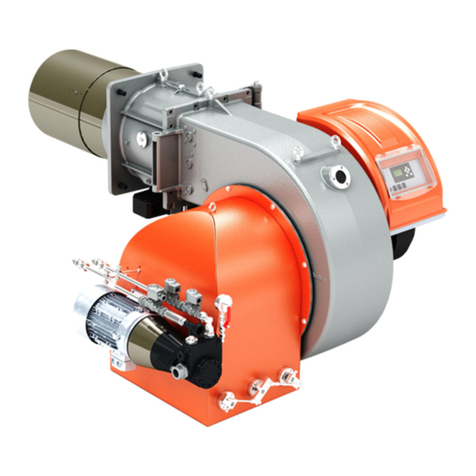
Carlin 702CRD User manual

Model 702CRD
Oil Burner
Installation and
Operating Instructions
For Use By Qualified Service Technicians Only
It is important that the installation of the oil burner,
piping and fittings, safety devices, controls, electrical
wiring and equipment be done in accordance with
national and/or local regulations of the authorities
having jurisdiction over such installation.
126 Bailey Rd North Haven, CT 06473
Ph 203-680-9401 Fx 203-680-9403
Tech Support 800-989-2275 carlincombustion.com
Carlin Combustion Technology, Inc.
The model 702CRD burner is designed
to fire No. 2 fuel oil and is a low-high-low-off
(step modulating) high-speed flame retention
burner. Oil flow-rate is step-modulated by
the use of two oil valves with a dual pressure
fuel unit. Combustion air is controlled by
a damper motor. Its end-switch energizes
the second stage valve as the air shutter
approaches the open position.
Model 702CRD is currently for use on
H.B. Smith “18” series, Weil-McLain “88”
series and Burnham “V9” series boilers. Other
applications should be reviewed with Carlin
factory support personnel if questionable.

2
ASSEMBLING THE BURNER (TWO-PAK)
1. Remove the air tube and nozzle line assembly from
the smaller carton. If nozzles are not installed, see
instructions under (4).
2. Remove the main housing assembly from the larger
carton.
3. Install air tube assembly in housing using set screws
provided. Be sure air tube is fully seated against
step in housing.
4. Install and tighten the proper nozzles (Table 3,
Page 4) in the adapter. Be careful not to damage the
electrode insulators or to bend the wires.
Figure 1. Electrode settings
5. Check the electrode settings (Figure 1).
6. Swing open the transformer, and slide the nozzle
line assembly into the air tube. The flame retention
ring must be lifted and guided through the throttle
ring (a reduced diameter) in the end of the air tube.
DO NOT FORCE IT.
7. Fasten the high tension leads to the transformer
terminals.
8. Place the nozzle line yoke in the groove in the ad-
justing screw.
9. Swing the transformer to the closed position.
10. Connect the flared fitting on the copper oil line to the
nozzle line and tighten.
11. See sections on Page 5 for adjustments of combus-
tion head and combustion air.
DIMENSIONS
VENTILATION
Boiler room areas of commercial buildings of normal
construction generally do not allow for sufficient air
infiltration. Provision must be made for an outside air
supply to the boiler room area. This is required because
combustion of oil consumes about 30 cfm of air per
1 GPH input. To ensure an adequate air supply, provi-
sion must be made for 30 cfm per 1 GPH plus 50°/o
additional for draft regulator.
Example:
Burner is firing at 6.00 GPH. 6 X 30 = 180 cfm. Add 50%
= 270 cfm. Install an opening of approximately 30 sq. in.
free area per 1 gallon per hour input. When louvers are
used, consider the free area half of the total.
Example:
Firing 6.00 GPH free area = 6 X 30 = 180 sq. in. A
louvered opening would be 180 X 2 = 360 sq. in. gross.
Fresh air louvers must be above ground level to prevent
obstruction by leaves and snow.
INSTALLING THE BURNER: FLANGE MOUNTED
1. Measure, in the burner opening, the distance from the
inside of the combustion chamber to the outside of
the mounting plate to find the insertion length of air
tube needed. Position flange (Figure 2) with sleeve
inside on air tube at a point from end of burner corre-
sponding to this measurement. Tighten set screws to
anchor flange. The flange is now located so that the
end of the burner will be flush, or almost flush, with
the inside of the combustion chamber.
2. Slide the end of the air tube into the opening and
secure the flange to the front plate.
INSTALLING THE BURNER: PEDESTAL MOUNTED
1. Adjust the pedestal (Figure 3) so that the height of the
air tube matches the location of the burner opening.
2. Slide the end of the air tube into the opening so that it
is flush or nearly flush with the inside of the combus-
tion chamber.
3. From the outside of the unit, seal the space around
the air tube with asbestos cement or equivalent.
Figure 2. Flange mounted Figure 3. Pedestal mounted

3
FIRING BOILERS WITH COMBUSTION CHAMBERS
The 702CRD burner operates with superior efficiency
and cleanliness in properly designed refractory-type
combustion chambers (Figure 4). Very wide tolerance to
burner adjustments and other variables is found when
these chambers are used.
Table 1 shows the recommended minimum inside
dimensions for refractory brick, refractory pre-cast and
pre- formed refractory fiber chambers. Due to their
quick warm-up properties, the light, insulating-type
materials are slightly preferable although these burners
show less dependence upon refractory temperature
than previous models. Refractory materials in boilers
and furnaces should be capable of withstanding
2600°F (1427°C) or higher.
The note accompanying Table 1 provides further details
relative to variations in dimensions and geometry.
TABLE 1
MINIMUM DIMENSIONS RECOMMENDED IN
REFRACTORY COMBUSTION CHAMBERS (Inches)
High Fire
Oil Delivery Rate
GPH @ 300 PSI
Length
“L”
Width
“W”
Dim.
“C”
Suggested
Height
“H”
Min. Dia.
Vertical
Cylinder
5.95 19 13.5 7.0 13 17
6.80 23 14.5 7.0 14 21
7.65 27 15.0 7.5 15 25
8.50 32 15.5 8.0 15 30
9.35 34 16.0 8.0 16 32
10.20 35 16.0 8.0 16 33
11.05 37 16.5 8.5 16 35
11.90 48 16.5 8.5 16 46
12.75 55 16.5 8.5 16 53
Note: These are minimum dimensions and each may be exceeded without much
effect.
FIRING BOILERS WITHOUT REFRACTORY
CHAMBERS
Depending upon the geometry of the combustion
space, some units perform better than others without
refractory (Figures 5 and 6). When the back wall of the
unit coincides approximately with the end of the flame,
a target of refractory material is usually required.
Table 2 shows minimum dimensions required for good
combustion without refractory. They may be exceeded
without much effect.
TABLE 2.
MINIMUM DIMENSIONS RECOMMENDED IN BOILERS
FIRED WITHOUT COMBUSTION CHAMBERS (Inches)
High Fire
Oil Delivery Rate
GPH @ 300 PSI
“L”
With
Target
“L”
Without
Target
Width
“W”
Dim.
“C”
Dim.
“D”
5.95 19 23 15.5 8.0 10.0
6.80 23 27 16.5 8.0 10.0
7.65 27 32 17.0 8.5 10.5
8.50 32 37 17.5 9.0 11.0
9.35 34 40 18.0 9.0 11.0
10.20 35 41 18.0 9.0 11.0
11.05 37 43 18.5 9.5 11.5
11.90 48 54 18.5 9.5 11.5
12.75 55 61 18.5 9.5 11.5
Figure 4. Brick combustion chamber (side view).
Figure 5. Wet leg boiler. No combustion chamber (side
view).
Figure 6. Scotch Marine boiler. No combustion chamber.

4
OPERATION
1. Call for heat. Burner motor and ignition are energized.
Air is in the low-fire position. The low-fire oil valve ad-
mits oil at 100 psi to the nozzle and its spray ignites,
burning clean with proper air/fuel ratio.
2. If demand exceeds low-fire, the damper motor
is energized through a high-fire operating control
(aquastat, airstat, pressuretrol, or outdoor thermo-
stat). As the damper motor approaches a half open
position, the auxiliary end switch energizes the high-
fire valve on the fuel unit, closing the by-pass port,
and increasing the nozzle pressure to 300 psi. Thus
the full fire with open air burns clean with high CO2
and high efficiency.
3. As the high-fire input begins to exceed the demand of
the high-fire operator, the operating control de-ener-
gizes the damper motor. As the damper motor returns
the air shutter to low-fire, the auxiliary end switch in
the damper motor de-energizes the high-fire valve
which drops the nozzle pressure to 100 psi.
4. If the demand exceeds low-fire, the high-fire operat-
ing control would again call for more heat as in Step 2
and then Step 3.
5. If, after returning to low-fire, the load should drop to
below the low-fire output, the operating limit would
shut off the burner completely.
It is important that the installation of the oil burner,
piping and fittings, safety devices, controls, elec-
trical wiring and equipment be done in accordance
with national and/or local regulations of the author-
ities having jurisdiction over such installation.
If adjustment to the damper motor is needed, please
reference the included supplement (Part# MNSQN71)
for all settings and operation.
NOZZLE SPECIFICATIONS
The 60° P Hago nozzle is the standard nozzle and usu-
ally provides the best fire. Substitutions are sometimes
recommended in specific packaged boilers.
Following is a list of nozzle specifications for packaged
boilers presently using the 702CRD burner:
Burnham Series V907 - V910: 70° B, Delavan
Burnham Series V911: 60° PLP Monarch
H. B. Smith Series 18: 9-11 Section, 45° P Hago
H. B. Smith Series 19: 7-11 Section, 60° P Hago
Weil-McLain 488, 488R: 60° PLP Monarch
Weil-McLain 588: 70° P Hago.
Other makes of nozzles may or may not prove satisfac-
tory.
For special applications, other specifications might pro-
vide a more desirable pattern.
FORCED DRAFT FIRING
Due to the back pressure in forced draft units, the max-
imum firing rate of a burner is reduced. The greater the
pressure, the lower the maximum GPH capability
becomes. Table 4 shows this. Note that the Table stops
at 0.70 inches W.C., the maximum recommended back
pressure for the 702CRD burner.
The combustion head settings for forced draft firing
would be somewhat greater than those shown in Table 3
which is for zero pressure or natural draft.
**The “low-fire” pump pressures shown are recommended. If higher low-fire
inputs are desired for a given situation, the low-fire pressure can be increased
only up to 200 PSI. Higher low-fire pressures will require higher low-fire air
openings.
**The “high-fire” pressure is set at the factory to 300 psi. This is the maximum
UL rating for the fuel unit, so higher pressures are not recommended.
HOW TO ADJUST THE COMBUSTION HEAD
The retention ring position ahead of the throttle ring is
adjustable from zero (flush) to 11⁄4inches (Dimension
Figures 7 and 8). Turning the adjusting screw (clock-
wise) increases the distance “A” ahead. This distance
is indicated by llfting the housing cover and reading
the scale on the nozzle line across the corners on sides
of the channel guiding the nozzle line. Each division is
1/16- inch.
Refer to “A” dimension (Table 3) for corresponding
nozzle selection. Example: 702CRD burner firing at 6.80
GPH high-lire setting, Column “A” reads 1/8-inch.
TABLE 3
NOZZLE DATA AND COMBUSTION
HEAD SETTINGS
Nozzle
Size
Low
Fire
Pres.*
Low
FIre
Rate
GPH
Heat
Setting
“A”
(inch)
Low
Fire “X”
Air
Open (inch)
High
Fire
Pres.**
High
Fire
Rate
3.50 100 3.50 0 3/8 300 5.95
3.75 100 3.75 1/16 3/8 300 6.38
4.00 100 4.00 1/8 3/8 300 6.80
4.50 100 4.50 3/16 3/8 300 7.65
5.00 100 5.00 1/4 3/8 300 8.50
5.50 100 5.50 5/16 3/8 300 9.35
6.00 100 6.00 7/16 7/16 300 10.20
6.50 100 6.50 5/8 7/16 300 11.05
7.00 100 7.00 7/8 1/2 300 11.90
7.50 100 7.50 11⁄41/2 300 12.75
TABLE 4
MAXIMUM FIRING RATES (GPH) – FORCED DRAFT

5
1. Turn adjusting screw counter clockwise until zero on
scale is aligned with rear of housing. (“A” equals zero,
see Figure 8.)
2. Now turn adjusting screw clockwise until the 1/8-inch
graduation on the scale coincides with rear of hous-
ing. Each mark (or line) is 1/16-inch. (See Figure 8.)
3. The retention ring will now be 1/8-inch ahead of the
throttle ring. (See “A” dimension, Figure 7.)
CAUTION: Housing cover should be raised slightly
when attempting to change retention ring setting (“A”
dimension) otherwise scale will be torn or distorted. This
can be done by backing out the two hold-down screws
2 to 3 turns, and then lifting cover slightly while adjust-
ing. Be sure to tighten screws after adjusting.
Figure 7. Dimension “A”.
Figure 8. Combustion Head Adjustment.
COMBUSTION HEAD ADJUSTMENT FOR
COMBUSTION AIR
When adjusting the combustion head forward or back,
the space around the rim of the retention ring is in-
creased or decreased which increases or decreases the
amount of combustion air to correspond with the nozzle
sizes used.
Also, by using the specified nozzle, the air fuel ratio for
both low and high-fire are optimized by the automatic
damper motor and its associated linkage. This linkage
has been pre-set at the factory and should not be ad-
justed. It is set to be in the fully open position when the
burner is in high-fire.
By adjusting the combustion head for the firing rate
delivered by the particular nozzle, the burner should de-
liver very close to the proper amount of combustion air
and CO2. Slight increases or decreases will usually be
required depending upon the draft. Normally a draft of
0.02 to 0.04 inches W.C. (negative pressure) is recom-
mended over the fire for natural draft applications.
Adjust the combustion head only while In high-fire. The
burner is provided with a low-fire air shutter adjusting
screw. This adjustment limits the amount of shutter clo-
sure which thereby increases or decreases the amount
of combustion air required for proper burning.
WIRING FOR LOW-HIGH-LOW STEP MODULATION
In order to take full advantage of the energy savings
potential of the 702CRD burner, it should be wired to
operate with low-high-low cycles. Hence, the firing cy-
cle would be much longer by going from low to high to
low once or several times before shutting off.
The following examples illustrate wiring for a “Water
Boiler” (Figure 9), and a “Steam Boiler” (Figure 10). In
each case we have a limit circuit which starts and stops
the burner and a high-fire control which brings the high-
fire on and off.
Also, pre-wired and built into the burner is a manual
high-fire switch which enables the installer or operator
to hold the burner on low-fire if so desired.
Refer to the appropriate example for your installation.
Figure 9. Wiring for Low-High-Low Step Modulation in
“Water Boiler”.
Example: Water Boiler
Operating Range: 170° - 190°F
2. Set Safety Hi Limit: Cut in 200 – Cut out 210
3. Set Operating Limit: Cut in 180 – Cut out 190
4. Set Hi-Fire Control: Cut in 170 – Cut out 180
Operation:
1. Call for heat; cold start. Burner starts on low and
goes to high-fire.
2. When the temperature rises to 180°F the burner goes
to low-fire.
3. If temperature drops to 170°F burner returns to
high-fire.
4. If temperature rises to 190°F burner shuts off.
NOTE: Since the calibrations on the limit controls are
seldom exact, it will be necessary to readjust the set-
tings during operation.

6
Figure 10. Wiring for Low-High-Low Step Modulation In
“Steam Boiler”.
Example: Steam Boiler
Operating Range: 3 to 6 PSI
2. Set Safety Hi Limit: Cut in 8 PSI – Cutout 10 PSI
3. Set Operating Limit: Cut in 5 PSI – Cut out 6 PSI
4. Set Hi-Fire Control: Cut in 3 PSI – Cut out 4 PSI
Operation:
1. Call for heat; cold start. Burner starts on low and
goes to high-fire.
2.
When pressure rises to 4 PSI the burner goes to low-fire.
3. If pressure drops to 3 PSI burner returns to high-fire.
4. If pressure rises to 6 PSI burner shuts off.
NOTE: Since the calibrations on the limit controls are
seldom exact, it will be necessary to readjust the set-
tings during operation.
FUEL UNIT AND OIL LINES
The 702CRD burner is provided with a two-stage
dual pressure fuel unit. Low-fire operating pressure is
100 PSI, adjusted by turning the slotted screw located on
top of the solenoid coil on the pump (See Figure 11.) The
high-fire operating pressure is 300 psi. The high pressure
is adjusted by the screw opposite the nozzle port on the
pump while the burner is in the high-fire mode.
Figure 11. Two-stage Dual Pressure Fuel Unit.
A single-pipe system is recommended whenever the
bottom ofthefuel tank is above the burner oris at the
same level as the burner. This includes outdoor fuel
tanks that are at such levels. The length of run should
not exceed 100 ft. and the vacuum should not exceed
12" mercury. Be sure the by-pass plug has been re-
moved for single-pipe systems.
A two-pipe system is recommended when the fuel tank
is below the level of the burner, and the fuel unit must
pull (lift) the fuel up to the burner. The vacuum reading
should not exceed 12" mercury. For two-pipe installa-
tions the by-pass plug must be installed.
Table 5 shows, for the standard two-stage fuel unit, the
allowable lift and lengths of 3/8" and 1/2" OD tubing for
both suction and return lines in two-pipe systems.
TABLE 5
TWO-PIPE SYSTEMS
Lift
(Feet)
Length of Tubing (Feet)
3/8" OD 1/2" OD
0 41 100
2 37 100
4 32 100
6 28 100
8 24 96
10 20 80
12 16 64
14 — 48
16 — 32
Be sure that all oil line connections are absolutely air-
tight. Check all connections and joints. Flared fittings
are recommended. Do not use compression fittings.
Open the air-bleed valve and start the burner. For clean
bleed, slip a 3/16" ID hose over the end of the bleed
valve and bleed into a container. Continue to bleed
for 15 seconds after oil is free of air bubbles. Stop the
burner and close the bleed valve.
LIGHT-OFF AND ADJUSTMENT
Before starting the burner, pre-set the retention ring po-
sition for the particular firing rate according to Table 3.
If the fire is a little too rich, move the combustion head
forward by increasing dimension “A,” Figures 7 and
8. At the lower inputs, a very slight change is usually
enough. DO NOT ALTER THE LINKAGE. IT IS PRE-SET
AT THE FACTORY.
Adjust draft to 0.02 to 0.04 inches W.C. over the fire for
natural draft units.
Run a smoke test. Strive for zero or a trace. Each time
further adjustment of retention ring is made, reset the
draft to 0.02 to 0.04 inches W.C. over the fire.
Check CO2. This should be 12 to 121⁄2%.
Check for good ignition and clean cut-off. If cut-off con-
tinues to be poor, look for air leaks in the suction line,
filters or valves and correct them.

7
For different boiler applications, it is sometimes nec-
essary to have the high-fire pull in earlier or later than
normal during the swing to achieve a smooth, cleaner
transition.
If the swing from low-fire to high-fire is rough, i.e., bangs
or rumbles, or is extremely smoky, the internaI end
switch of the damper motor is possibly not set correctly.
The high-fire should pull in when the air shutter (not the
damper arm) is about half way through its swing.
If the fire is lean all the way to high-fire, the high-fire
valve should be energized earlier. if during the swing,
the fire gets very smoky, then cleans up again, the high-
fire valve should be energized later.
To adjust the damper end switch, remove the damper
motor cover. This will expose a white plastic gear with
notches. With the burner off, use the end of a small
blade screwdriver inserted into one of the notches of the
white gear. Turn the gear one notch clockwise if a later
pull-in is required, or counter clockwise for an earlier
pull-in.
The linkage between the damper motor arm and the
air shutter crank is set at the factory and should only
need adjustment if the damper motor or damper rod is
replaced. With the burner in high-fire, there should be
minimal play in the connecting rod.
N O T E S

71761 110519© Copyright 2019 — Carlin Combustion Technology, Inc.
TECH SUPPORT HOTLINE 800-989-2275
Carlin Combustion Technology, Inc.
126 Bailey Road North Haven, CT 06473 Phone 203–680–9401 Fax 203–764–1714
Other manuals for 702CRD
1
Table of contents
Other Carlin Burner manuals

Carlin
Carlin 301GAS User manual

Carlin
Carlin 702CRD User manual

Carlin
Carlin 99FRD User manual

Carlin
Carlin 201CRD User manual

Carlin
Carlin EZ Series User manual

Carlin
Carlin 201GAS User manual

Carlin
Carlin EZ-1HPW Configuration guide

Carlin
Carlin 201CRD User manual

Carlin
Carlin 201CRD User manual

Carlin
Carlin 701CRD User manual

Carlin
Carlin EZ-1-HP User manual

Carlin
Carlin 102CRD 99FRD User manual

Carlin
Carlin 601CRD User manual

Carlin
Carlin EZGas Pro User manual

Carlin
Carlin EZ-66 User manual

Carlin
Carlin 201CRD User manual

Carlin
Carlin 702G/O User manual

Carlin
Carlin 801GAS User manual

Carlin
Carlin Flame Funnel 1050FFD User manual