
B+K precision B5927.406 User manual

User Manual
Pressure cooker | stainless steel | 6 litres
B5927.406
E
Including
4recipes

Contents
Congratulations on purchasing this BK refined
stainless steel pressure cooker. We recommend
that you read these instructions carefully and
keep the manual safely.
Introduction 3
Instructions for safe use 4
Parts and use 6
Pressure regulator 8
Operating instructions 9
Food preparation instructions 9
Cooking and heating 10
Cleaning 12
Cooking diagram 13
Packaging list 13
Resolving problems 14
Maintenance and guarantee 16
Recipes 18
Diameter
Product information
Capacity Working Pressure
22 cm 50 KPa - Position 1
90 KPa - Position 2
2
6 litres (usable
capacity 4 litres)
E

The pressure cooker works under pressure that is built up in the pan.
Under pressure, the internal temperatures in the pan rise above the
normal boiling point of water, so that food is cooked more rapidly.
Introduction
Faster
The BK pressure cooker cooks food 3 times faster than other methods
of cooking. Meals that would usually take half an hour to prepare can be
on the table in just 10 minutes!
Tastier
Food tastes better when it is prepared in a BK pressure cooker. The
shorter cooking time enables retention of the natural flavours. Half as
many herbs are needed and less or no flavour is lost during cooking.
A significant difference with, for example, a microwave is that meat is
cooked faster in a BK pressure cooker and it becomes golden brown.
Delicious!
Healthier
In a BK pressure cooker, the food retains important vitamins and
minerals. We all know that the longer food is cooked for, the more
nutrients can be lost. In a BK pressure cooker, twice as many vitamins
and nutrients are retained in comparison to the usual cooking methods.
Pressure cooking also prevents the loss of vitamins and minerals, where-
by less water has to be used.Take a look at the recipes (from page 18
onwards) for the versatile uses.
3
X X
Suitable heat sources:
E

Instructions for safe use
When using the pressure cooker, always follow the
instructions for safe use.
1. Read these instructions properly and thoroughly.
2. Do not let children near to the pressure cooker when in use.
3. Only use the pressure cooker on the indicated heat sources
(see page 3). Do not place the pressure cooker in a hot oven or
microwave.
4. Take great care when moving a pressure cooker. Do not touch the
hot pan or lid; use the handle and side grip, if necessary use oven
gloves or pan holders.
5. Do not use the pressure cooker for purposes other than the one for
which it is intended.
6. This pressure cooker cooks under pressure. Incorrect use can
result in burns. Before use, make sure that the pressure cooker is
properly closed and locked using the sliding knob. Refer to
“Operations Instructions” from page 9 onwards. Never use the pan
without attaching the lid securely.
7. Never use the pressure cooker without adding liquid as this can
seriously damage the pan. Use a minimum of 250 ml of liquid.
8. Before use, always check the pressure regulator to ensure this is not
blocked. Refer to page 12.
9. Fill the pan up to no more than 2/3 of the pressure cooker’s capa-
city. This is the usable capacity (shown in the pan by “4.0 L: MAX”).
When cooking food that expands during cooking, such as rice or
dried vegetables, do not fill the pressure cooker to any more than
half of the capacity.
10. When the intended pressure has been reached and the pressure
indicator is fully raised, adjust the heat source. This prevents excess
amounts of steam from escaping, the food from burning and the
pan from being damaged.
4
E

11. When you release pressure from the pan using the setting
‘depressurise completely ’, the escaping steam can harm you. Only
change the setting of the pressure regulator using the small knob
on the valve.
12. Never use force when opening the lid of the pressure cooker.
Do not open the lid until the pressure indicator shows that all
internal pressure has subsided. Refer to “Operating Instructions”
from page 9 onwards.
13. When you cook meat in the pressure cooker which has an outer
layer of skin which could potentially swell due to the effects of
pressure, do not pierce the skin if this appears swollen; you could
get burnt.
14. When cooking pasta in the pressure cooker, the pan should be
shaken before carefully opening to prevent burns caused by food
spurting out.
15. Applesauce and compotes must not be prepared in the pressure
cooker; these mixtures can froth and splatter and potentially block
the pressure regulator.
16. Never use the pressure cooker under pressure to deep-fry or fry food.
17. Do not attempt to repair the pressure cooker yourself, this would
invalidate the guarantee. You may only carry out the maintenance
activities described in this User Manual.
18. Replace the silicon ring (see page 7, part 10) after approximately
400 uses, or every 2 years.
19. Use only the appropriate BK spare parts specifically intended for
this model. Only use the lid and pan that are part of the same model.
20. Please note: the lid must not be cleaned in the dishwasher.
This harms the safety system, which can lead to dangerous situations.
21. Keep these instructions!
5
E

Parts
and use
1
3
2
1. Safety valve with pressure indicator.
2.The screw of the pressure regulator. Do not unscrew.
3.Silicon sealing ring of the pressure indicator.
Do not remove!
6
E
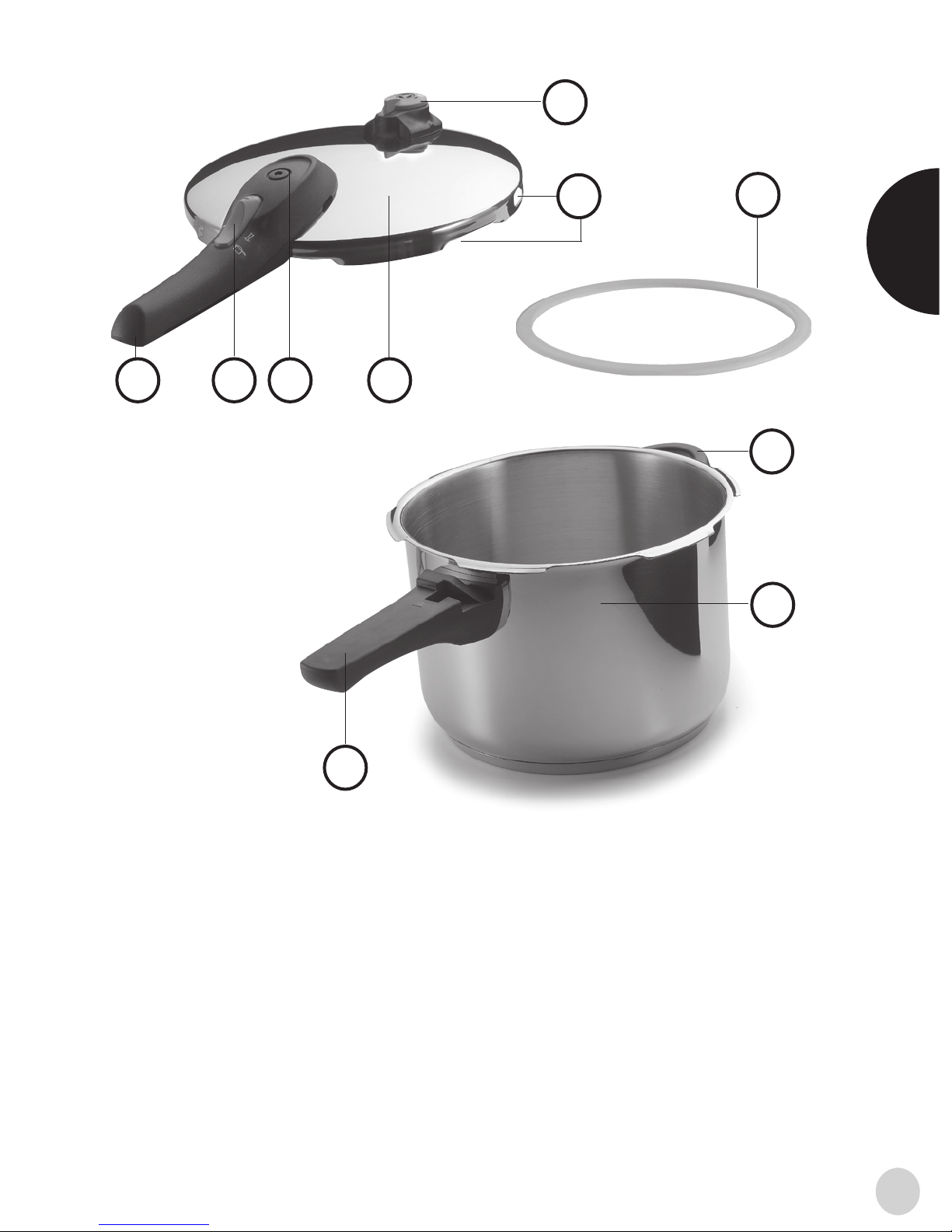
13
11
12
4 5 6 7
8
910
4. Lid handle 5. Sliding knob. To lock and unlock the lid. 6. Pressure
indicator. When this rises, the pan is under pressure and the lid may
not be opened. 7. Lid. 8. Pressure regulator. Mechanism to regulate
the pressure. 9. Safety openings. A safety mechanism to reduce excess
pressure. When the pressure is too high, the silicon ring will push
outwards. 10. Silicon ring. Seals the pan. 11. Helper handle of the pan.
12. Pan. 13. Pan handle.
7
E

Pressure regulator
Mechanism with which to regulate
the pressure:
2 significant pressure – 90 KPa.
1little pressure – 50 KPa.
fully ventilate
Ø
remove valve from the pressure
regulator.
Parts and use continued
14
15
14. Insert basket.
15.Insert basket trivet. Fold outwards before use.
Place the insert basket on the trivet and place like this in the pan.
To steam your meal under pressure.
8
E

Before using the pressure cooker for the first time, it is important to
read all instructions, particularly the instructions for safe use
(see page 4).
Remove all the packaging material and accessories. Lubricate the silicon
ring with a little olive oil, so that it is easier to open and close the lid.
Clean the pan and lid before using for the first time with mild soapy water.
Operating Instructions
Food preparation Instructions
Place the food and the liquid (not less than ¼ of a litre) in the pan.
The content (water, soup, gravy or drink) has to be able to produce
steam when this is heated up. Therefore do not fill the pan more than
2/3 (4.0 L: MAX) full. For foods that swell during cooking, such as rice
and dried vegetables, do not fill the pan more than half way.
Warning:Before closing the pressure cooker, check that the pressure
regulator (8) is clean. Check the safety openings (9) to check that these
are clean. Make sure that the silicon ring (10) is in the edge of the lid.
Check that the valve of the pressure indicator (1) functions correctly
(also refer to page 12). Make sure that the silicon sealing ring of the
pressure indicator (3) is present.
9
4,0 L : MAX
E

1. Link up the
0 symbol on the
lid handle with the
∆symbol of the
pan handle.
Cooking and heating
Closing the lid
2.Turn the lid
clockwise until the
lid handle and
pan handle are
connected to one
another.
3.Once the lid is
closed, lock the
pan and lid using
the sliding knob.
1.Move the pressure cooker by holding
both the helper handle and the handle.
Place the pan on a stable heat source.
2.When using gas, keep the flame under the
base of the pan to protect the handles.
If using on electric, ceramic or induction heat
sources, the cooking zone has to be even to
the base of the pan.
3.The pressure regulator can be set in
2 cooking positions.
1 For normal food preparation
(50 KPa).
2For rapid preparation or food with a
longer cooking time (90 KPa).
10
E
Table of contents


