Belkin WRE/AP User manual

F5D7130uk
2.4GHz • Wireless
802.11b
Ethernet
E
Wired
Mbps
10/100
Ethernet
Gigabit
E
Wired
Mbps
10/100/1000
Gigabit Ethernet
2.4GHz • Wireless
HSM
802.11g
Mbps
2.4GHz • Wireless802.11g
Mbps
Range Extender:
Increase your wireless
coverage area
Access Point:
Add wireless access to your
wired network
Wireless G
Range Extender/
Access Point
User Manual

Table of Contents
1 Introduction ......................................................................1
Advantages of a wireless network ............................................ 1
Placement of your Wireless Networking
Hardware for Optimal Performance ........................................... 2
2 Overview ...........................................................................5
Package Contents ...................................................................... 7
System Requirements ................................................................ 7
Product Specifications ............................................................... 7
3 Configuring the WRE/AP ....................................................8
Configuring as a Wireless Range Extender ................................ 9
Configuring as a Wireless Access Point ....................................13
Configuring as a Wireless Bridge ..............................................14
Setting up Wireless Bridging .....................................................15
4 Using the Web-Based User Interface ............................... 17
Accessing the Web-Based Setup .............................................18
Understanding the Web-Based User Interface .........................18
Channel and SSID .................................................................... 20
Using the Wireless Mode Switch ............................................. 21
Turbo Mode and Protected Mode ............................................ 22
Changing the Wireless Channel ............................................... 23
Using the Broadcast SSID Feature .......................................... 23
Securing your Wi-Fi® Network ...................................................24
WEP Setup ............................................................................... 29
WPA Setup* ...............................................................................31
MAC Address Control ............................................................. 33
5 Changing System Settings ...............................................34
Setting or Changing the Administrator Password .................... 34
Restoring Factory Default Settings .......................................... 34
Saving a Current Configuration ................................................ 35
Restoring a Previous Configuration ......................................... 37
Updating Firmware ................................................................... 38
6 Troubleshooting ..............................................................42
7 Information ..................................................................... 51

section
1
2
3
4
5
6
7
1
Thank you for purchasing the Belkin Wireless G Range Extender/Access
Point (WRE/AP) and welcome to the world of wireless networking. Now
you can take advantage of this new high-speed wireless technology and
gain the freedom to connect to your home or office network without using
cables. This product acts as a wireless range extender, access point, and
bridge. The easy installation and setup will have you networking wirelessly
in minutes. Please be sure to read through this User Manual completely,
and pay special attention to the section entitled “Placement of your
Wireless Networking Hardware for Optimal Performance” on the next page.
By following our simple setup instructions, you will be able to use your
Belkin Home Network to:
• Share one high-speed Internet connection with all the computers in
your home
• Share resources, such as files, and hard drives among all the
connected computers in your home
• Share a single printer among the entire family
• Share documents, music, video, and digital pictures
• Store, retrieve, and copy files from one computer to another
• Simultaneously play games online, check Internet e-mail, and chat
Advantages of a wireless network
• Mobility – you no longer need a dedicated “computer room”—now
you can work on a networked laptop or desktop computer anywhere
within your wireless range
• Easy installation – Belkin Easy Installation Wizards make setup simple
• Flexibility – set up and access printers, computers, and other
networking devices from anywhere in your home
• Easy Expansion – the wide range of Belkin networking products let
you expand your network to include devices such as printers and
gaming consoles
• No cabling required – you can spare the expense and hassle of
retrofitting Ethernet cabling throughout the home or office
• Widespread industry acceptance – choose from a wide range of
interoperable networking products
Introduction

Placement of your Wireless Networking Hardware for
Optimal Performance
Your wireless connection will be stronger the closer your computer is
to your Wireless Router or Access Point. Typical indoor operating range
for your wireless devices is between 100 and 200 feet. Your wireless
connection speed and performance will degrade somewhat as the distance
between your Wireless Router (or Access Point) connected devices
increases. This may or may not be noticeable to you. Factors that can
weaken signals simply by getting in the way of your network’s radio waves
are metal appliances or obstructions, and walls.
To test whether performance issues are related to range or obstruction
factors, try moving the computer to a position between five and ten feet
from the Wireless Router or Access Point. If difficulties persist even at
close range, please contact Belkin Technical Support.
Note: While some of the factors suggested below can affect network
performance negatively, they will not prohibit your wireless network
from functioning. In fact, you may not notice any problem at all. If
you are concerned that your network is not operating at its maximum
effectiveness, this checklist may help.
1. Wireless Router or Access Point Placement
Place your Wireless Router or Access Point, the central connection point
of your network, as close as possible to the center of your wireless
network devices.
To achieve the best wireless network coverage for your “wireless clients,”
(i.e. computers enabled by Belkin Wireless Notebook Network Cards,
Wireless Desktop Network Cards, and Wireless USB Adapters):
• Ensure that your Wireless Router’s (or Access Point’s) networking
antennas are parallel to each other, and are positioned vertically
(pointing toward the ceiling). If your Wireless Router (or Access Point)
itself is positioned vertically, point the antennas as much as possible
in an upward direction.
• In multistory homes, place the Wireless Router (or Access Point) on a
floor that is as close to the center of the home as possible. This may
mean placing the Wireless Router (or Access Point) on an upper floor.
• Try not to place the Wireless Router (or Access Point) near a cordless
2.4GHz phone.
32
Introduction

32 32

section
1
2
3
4
5
6
7
33
3
Introduction
2. Avoid Obstacles and Interference
Avoid placing your Wireless Router (or Access Point) near devices that
may emit radio “noise”, such as microwave ovens. Dense objects that can
inhibit Wireless communication can include:
• Refrigerators
• Washers and/or dryers
• Metal cabinets
• Large aquariums
• Metallic-based UV tinted windows
If your wireless signal seems weak in some spots, make sure that objects
such as these are not blocking the signal’s path between your computers
and Wireless Router (or Access Point)
3. Cordless Phone Placement
If the performance of your wireless network is impaired after attending
to the above issues, and you have a cordless phone:
• Try moving cordless phones away from Wireless Routers or Access
Points and your wireless-enabled computers
• Unplug and remove the battery from any cordless phone that operates
on the 2.4GHz band (check manufacturers information). If this fixes
the problem, your phone may be interfering.
• If your phone supports channel selection, change the channel on the
phone to the furthest channel from your wireless network, as possible.
For example, change the phone to channel 1 and move your Wireless
Router (or Access Point) to channel 11. See your phone’s user manual
for detailed instructions.
• If necessary, consider switching to a 900MHz or 5GHz cordless
phone.

PB4
Introduction
4. Choose the “quietest” channel for your wireless network
In locations where homes or offices are close together, such as apartment
buildings or office complexes, there may be wireless networks nearby that
can conflict with yours. Use the Site Survey capabilities of your Wireless
LAN Utility to locate any other wireless networks, and move your Wireless
Router (or Access Point) and computers to a channel as far away from
other networks as possible.
Experiment with more than one of the available channels, in order to find
the clearest connection and avoid interference from neighboring cordless
phones or other wireless devices.
For more Belkin wireless networking products, use the detailed Site Survey
and wireless channel information included in your User Guide.
For more information regarding our networking products, visit our website
at www.belkin.com/networking or call Belkin Technical Support.
5. Secure connections, VPNs, and AOL
Secure connections typically require a user name and password, and are
used where security is important. Secure connections include:
Secure connections can be interrupted by a computer’s power
management setting, which causes the computer to “go to sleep.”
The simplest solution to avoid this is to simply reconnect by re-running the
VPN or AOL software, or by re-logging into the secure website. A second
alternative is to change your computer’s power management settings so
it does not go to sleep; however, this may not be appropriate for portable
computers. To change your power management setting under Windows,
see the “Power Options” item in the Control Panel. If you continue to have
difficulty with Secure Connection, VPNs, and AOL, please review the steps
above to be sure you have addressed these issues.

1
2
3
4
5
6
7
section
5
Front Panel
LAN
DC 5V/2.0A
Power/Ready LED LAN (Network) LED Wireless LAN LED
Power/Ready LED
Indicates that the WRE/AP is receiving power
OFF WRE/AP is OFF
Blinking Green WRE/AP is booting up
Solid Green WRE/AP is ready
Wireless LAN LED
OFF Wireless Network is OFF
Blinking Green Wireless Network is booting up
Solid Green Indicates wireless activity is ready
LAN (Network) LED
OFF No network is linked to the port
Green 10Base-Tx device connected
Orange 100Base-Tx device connected
Blinking (Orange or Green) Port activity
Overview

76
Overview
76 76
Antennas
RJ45 Ethernet
Jack
Power Jack
Reset button
Power Jack
Connect the included 5V DC power supply to this jack.
RJ45 Ethernet Jack
Connect an Ethernet cable to this socket, and connect to an open RJ45
10Base-T or 100Base-Tx port on a switch, hub, or WRE/AP.
Reset Button
The “Reset” button is to be used in the unlikely event that your WRE/AP
malfunctions. Resetting the WRE/AP restores its normal operation while
maintaining the programmed settings. You can also restore the factory
default settings by using the Reset button. Use the restore option if, for
example, you have forgotten your password.
a. Resetting the WRE/AP
Push and release the Reset button. The lights on the WRE/AP will
momentarily flash. The Power/Ready light will begin to blink. When
the Power/Ready light becomes solid again, the reset is complete.
b. Restoring the Factory Defaults
Press and hold the Reset button for 10 seconds, then release it.
The lights on the WRE/AP will momentarily flash. The Power/Ready
light will begin to blink. When the Power/Ready light becomes solid
again, the restore is complete.
Rotatable Dual Dipole Antennas
Two unidirectional dipole antennas are located on the side of the WRE/AP.
The antennas can rotate 180 degrees. The antennas should be oriented in
the vertical position for best performance.
LAN
DC 5V/2.0A

section
1
2
3
4
5
6
7
77
7
Overview
Package Contents
• Belkin Wireless G Range Extender/Access Point
• Power Supply
• User Manual
• Quick Installation Guide
• Registration Card
System Requirements
• At least one computer with an installed 802.11g or 802.11b-compliant
wireless Ethernet adapter
• TCP/IP networking protocol installed on each computer
• Ethernet networking cable (or better)
• Microsoft® Internet Explorer 4.0 or later, or Netscape® 4.0 or later
Product Specifications
Wireless:
Radio Technology Direct Sequence Spread Spectrum (DSSS)
Data Rate 802.11b: 11, 5.5, 2, 1Mbps 802.11g: 54, 48,
36, 24, 18, 12, 9, 6Mbps
Modulation 802.11b: CCK, DQPSK, DBPSK
802.11g: OFDM
Operating Frequency 2.412-2.497GHz ISM band
Operating Channels 802.11b: 11 for North America, 14 for Japan,
13 for Europe 802.11g: 13 for North America,
13 for Japan, 13 for Europe
Security 64-/128-bit WEP, WPA
Protocol Supported: CSMA/CD, TCP, IP, UDP
Management: Browser-based
Maximum Users: 32 (WLAN)
Ports: 1 10/100Base-Tx RJ45 port
1 power jack
1 reset button
LEDs: Power
LAN activity
WLAN activity

98
98
You can configure your Wireless G Range Extender/Access Point
(WRE/AP) in three modes, for three applications:
Wireless Range Extender Mode—widens the coverage area of your
wireless network
Wireless Network Access Point Mode—adds wireless-equipped
computers to an existing wired network
Wireless Bridge Mode—joins two wireless network segments together
Note: The Wireless Range Extender feature works with the following
models only:
Belkin Wireless G Router (F5D7230-4)
Belkin Wireless G Range Extender/Access Point (F5D7130)
Configuring the WRE/AP
This manual suits for next models
1
Table of contents
Other Belkin Wireless Access Point manuals

Belkin
Belkin F8T030 - Bluetooth Access Point User manual

Belkin
Belkin Range Extender/ Access Point User manual

Belkin
Belkin F5D7130 - Wireless G Access Point User manual

Belkin
Belkin F5D7130 - Wireless G Access Point User manual

Belkin
Belkin F5D7130 - Wireless G Access Point Reference guide

Belkin
Belkin F5D6130 Reference guide

Belkin
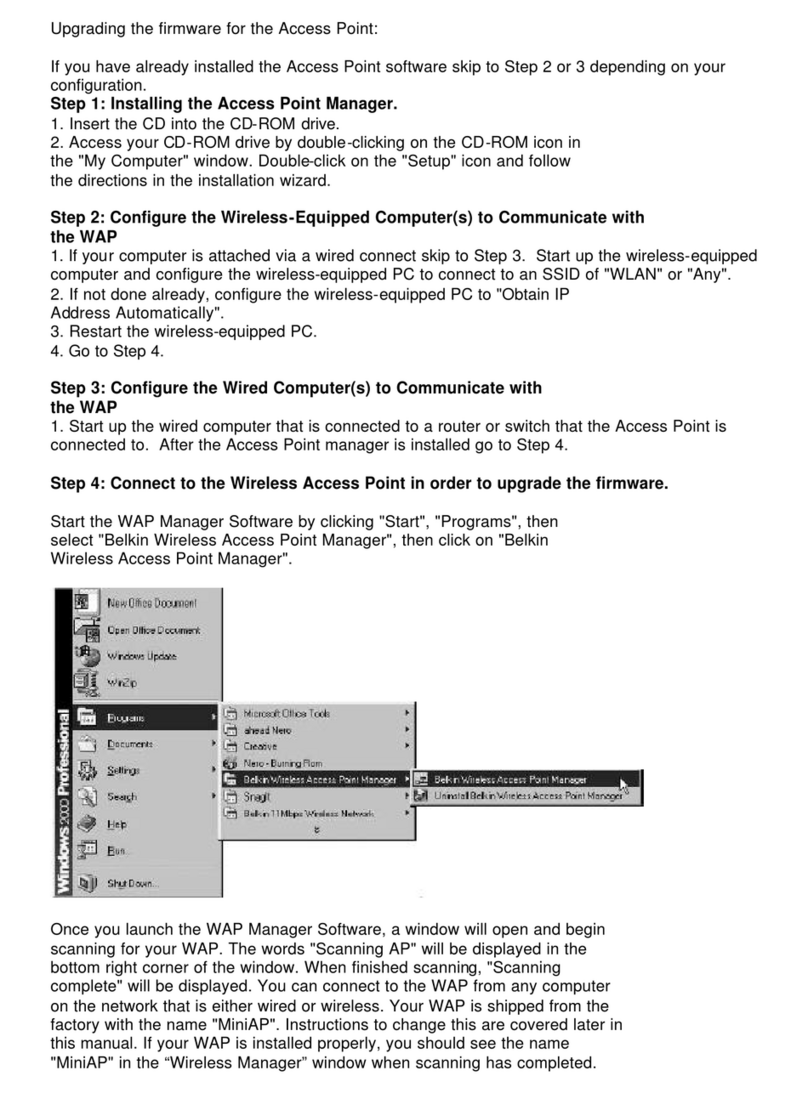
Belkin APFIRMWARE User manual

Belkin
Belkin F8T030 - Bluetooth Access Point Instruction Manual

Belkin
Belkin F5D7132 - Wireless G Universal Range Extender/Access... User manual

Belkin
Belkin F5D7130 - Wireless G Access Point Installation instructions