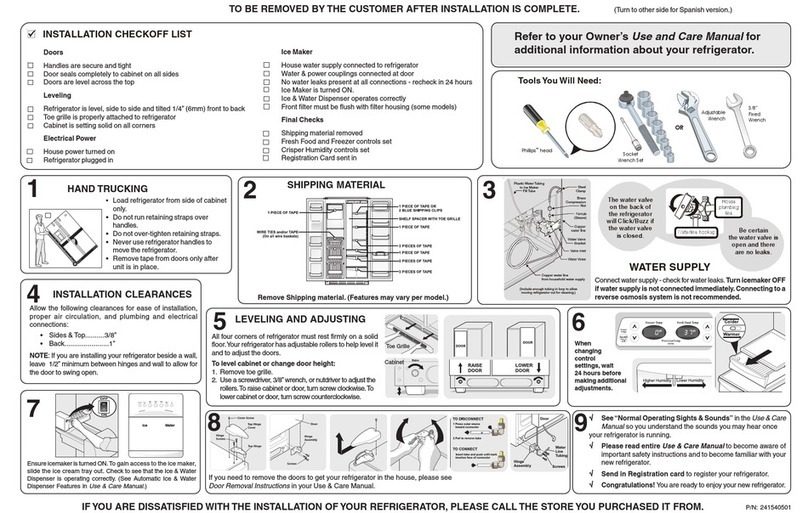
Beko BCNA275E4FN User manual


Please read the operating instructions first!
Dear Client,
We hope that your product, which has been manufactured in modern
factories and checked under the most meticulous quality control
procedures, will help you effectively.
For this reason, we recommend that you carefully read the entire user
manual for your product before using it, and then keep it for future use.
This manual
• Help you use your product quickly and safely.
• Read the manual before installing and operating your product.
• Follow the instructions, especially those relating to safety.
• Keep this manual in an easily accessible place as you may need it later.
• In addition, also read the other documents supplied with your product.
• Please note that this manual may also be valid for other models.
Symbols and descriptions
You will find the following symbols in this manual:
VSImportant information or tips.
ATWarning of conditions dangerous to life and property.
BElectrical voltage warning.
WARNING!
To ensure normal operation of your appliance which uses an ecological
refrigerant, R600a (inflammable only under certain conditions) you must respect
the following rules:
•Do not prevent the free circulation of air around the device.
•Do not use mechanical devices to accelerate defrosting, other than those
recommended by the manufacturer.
•Do not destroy the refrigeration circuit.
•Do not use electrical appliances inside the compartment to store food, except
those which may be recommended by the manufacturer.

TABLE OF CONTENTS
1 Your refrigerator 3 4 Preparation 10
2 Important Safety
Precautions
5 Using the refrigerator 11
4Control Keys................................11
Dual refrigeration system ..............12
Recommended use.................................4
General Safety...................................4 Defrosting ................................12
Low temperature compartment....12
HarvestFresh ...................................13
For appliances equipped with a water
cooler .................................................. ........6
Child safety................................6
Warning on the use of
refrigerants ................................. . . . . . . . . . . 6
Energy-saving measures..........................6
6 Care and cleaning 14
Protection of plastic
surfaces ...........................................14
3 Setup 7
Things to consider when moving your
refrigerator ..................................................
7
Before turning on your
refrigerator ........................................... ...7
Electrical connection...................7
Disposal of the packaging .............8
Disposal of your old
refrigerator ............................................8
Layout and Installation ...................8
Bulb replacement
7 Troubleshooting 15
interior ................................................8
Reversibility of doors....................9
2FR

1Your refrigerator
1
2
311
4
5
14
6
7
12
8
913
10
15
1. Control panel
2. Interior lighting
3. Refrigerator fan
4. Bottle support shelf
5. Glass shelves
6. 0°C compartment
7. Crisper cover
8. Crisper drawer
9 Quick freezing compartment
10. Freezer compartments 1
Adjustable shelves
2 Bottle shelf 3 Freezer fan 4
Refrigerator compartment 5
Freezer compartment
VSThe illustrations presented in this user manual are schematic and may not
correspond exactly to your product. If any parts shown are not
included in the product you purchased, they are valid for other models.
3FR

2Important Safety Precautions
Please review the following information:
Failure to follow these instructions may
result in injury or property damage.
Otherwise, any commitment related to the
guarantee and the reliability of the
product becomes invalid.
• For products equipped with a freezer
compartment: do not place bottled
or canned drinks in the freezer
compartment. This can cause them
to burst.
• Do not touch frozen products with
your hands, they could stick to
them. Unplug your refrigerator
before cleaning or defrosting it.
• Steam and pulverized cleaning
materials should never be
used for
process of cleaning or defrosting
your refrigerator. Steam could
penetrate electrical parts and cause
short circuits or electric shocks.
• Never use parts of your refrigerator
such as the door,
as a support or a step.
• Do not use electrical appliances
inside the refrigerator.
• Do not damage the parts through
which the refrigerant liquid
circulates with drilling or cutting
tools. The coolant that could
escaping if evaporator gas lines,
extension tubes or surface
coverings are punctured, may
irritate skin and cause eye injury.
• Do not cover or block the ventilation
holes of the refrigerator.
• Electrical devices may only be
repaired by authorized persons.
The
Repairs carried out by people who
do not have the required skills may
present a risk for the user.
• In the event of a malfunction or
during maintenance or
repair, disconnect the power supply
to the refrigerator either by
deactivating the corresponding fuse
or by unplugging the appliance.
Original spare parts are available for
10 years from the date of purchase of
the product. •
Recommended use
This product is intended for a
use:
• indoors and in enclosed areas
such as homes;
• in closed work environments, such
as shops and offices;
• in closed places of accommodation, such
as farms, hotels, boarding houses.
• It should not be used outdoors.
General Safety
• Before disposing of your
appliance, please consult the
local authorities or your retailer to
find out about the procedure and
approved collection bodies.
• Consult the authorized service center
regarding any questions or problems
relating to the refrigerator. Do not
intervene or allow anyone to intervene
on the refrigerator without informing
the authorized after-sales service.
• For products equipped with a
freezer compartment:
do not eat ice cream cones or ice
cubes
immediately after taking them
out of the freezer compartment!
(This may cause
frostbite in your mouth).
FR

• Do not pull on the cable when
unplugging the plug.
• Place alcoholic beverages
upright, in properly sealed
containers.
• Never store aerosols containing
substances
flammable and explosive in the
refrigerator.
• Do not use mechanical tools or
other devices to speed up the
defrosting process other than
those recommended by the
manufacturer.
• This product is not intended for
use by persons (including
children) with disabilities
physical, sensory, mental, or
inexperienced, unless they have
obtained permission from those
responsible for their safety.
• Do not operate a damaged refrigerator.
Consult the authorized service in the
event of a problem.
• The electrical safety of the refrigerator
is only ensured if the earthing system
of your home complies with the
standards in force.
• Exposing the product to rain,
snow, sun, or wind poses
electrical safety hazards.
• Contact the authorized service
when a power cable is damaged
to avoid any danger.
• Never plug the refrigerator into the
wall outlet during installation. You
would put yourself at risk of death
or serious injury.
• This refrigerator is designed for
food storage only. Therefore, it
should not be used for any other
purpose.
• The label with the technical
characteristics is located on the
left wall inside the refrigerator.
• Never connect your refrigerator to
energy saving systems, this may
damage it.
• If there is a blue light on the
refrigerator, do not view it with
optical tools.
• For manually controlled
refrigerators, wait at least 5
minutes to turn on the refrigerator
after a power outage.
• If this device were to change
ownership, do not forget to give
this user manual to the new
beneficiary.
• Avoid damaging the power cable
when transporting the refrigerator.
Twisting the cable can cause a fire.
Never place heavy objects on the
power cable.
•Avoid touching the plug with wet
hands when plugging in the
device.
• Avoid plugging in the refrigerator
when the electrical outlet has
failed.
• For safety reasons, avoid spraying
water directly on the external and
internal parts of the refrigerator.
• Do not spray substances
containing flammable gases
such as propane near the
refrigerator to avoid the risk of
fire and explosion.
• Never place containers containing
water on your refrigerator, they
could cause electric shocks or a
fire.
• Avoid overloading the refrigerator
with an excessive amount
of food. If it is overloaded, food
may fall out, hurting you and
damaging the refrigerator
when you open the door.
• Never place objects on top of the
refrigerator, they could fall when
you open or close the door of the
refrigerator.
FR

• Products that require precise
temperature control (vaccine, heat-
sensitive medication, scientific
materials, etc.) should not be
stored in the refrigerator.
• If the refrigerator is not used for a
long time, it should be unplugged.
A problem with the power cable
could cause a fire.
• The end of the electrical outlet must
be cleaned regularly with a dry
cloth, otherwise it may cause a
fire.
• The refrigerator can move if its adjustable
feet are not firmly fixed on the floor.
Fixing the adjustable feet securely on the
floor can prevent the
refrigerator to move.
• When carrying the refrigerator,
do not hold it by the door
handle. It can break it.
• When you need to place your product
near another refrigerator or
freezer, the distance between the
appliances should be at least 8 cm.
Otherwise, the adjacent walls may be
dampened.
In case of damage, keep your product
away from any potential source of flames
that could cause the device to catch fire.
Also, place the product in a ventilated
room.
Disregard this warning if your
device's cooling system
contains R134a.
The type of gas used in the appliance is
mentioned on the identification plate located
on the left wall of the interior of the
refrigerator.
Never throw the appliance into a
fire to get rid of it.
Energy saving measures
• Do not leave refrigerator doors open
for long periods of time.
• Do not put hot food or drinks in
the refrigerator.
• Do not overload the refrigerator so as
not to obstruct the air circulation
inside.
• Do not install the refrigerator in direct
sunlight or near appliances
emitting heat such as an oven,
dishwasher or radiator. Maintain a
distance of at least 30 cm between
your refrigerator and any heat
source, and at a distance of 5 cm
from an electric oven.
For devices with a water
cooler
The water supply pressure should
be between 1 and 8 bar.
• Use only potable water.
• Be sure to store your food in closed
containers.
• For products equipped with a freezer
compartment: you can keep the
maximum amount of food in the
freezer when you remove the freezer
shelf or drawer. The energy
consumption specified for your
refrigerator has been determined with
the freezer shelf or drawer removed
and at maximum load. There is no risk
in using a shelf or a drawer depending
on the shapes and sizes of the food to
be frozen.
Child safety
• If the door has a lock, the key should
be kept out of reach of children.
• Children should be supervised and
prevented from playing with the product.
Warning on the use of
refrigerants
If your device's cooling system
contains R600a:
This gas is flammable. Therefore,
please take care not to damage the
cooling system and piping when
using or transporting it.
• Defrosting food in the refrigerator
compartment saves energy and
preserves food quality.
6FR

3Installation
BIn the event that the information
contained in this manual has not
been taken into account by the
user, the manufacturer will not be
responsible for any problems.
.When the compressor starts
working, it will make a sound. Liquid
and gases built into the refrigerator
system can also make noise whether
the compressor is running or not. This
is completely normal.
5.The front parts of the refrigerator
can heat up. This phenomenon is
normal. These areas must in
principle be warm to avoid any risk
of condensation.
Things to consider
when making
move of your
fridge
1.Your refrigerator must be
unplugged.
2.Before transporting your refrigerator,
you must empty it and
Electrical connection
Connect your refrigerator to an
electrical outlet protected by a fuse of
the appropriate capacity.
Important:
clean it. Before packing your
refrigerator, you must secure its
shelves, drawers, accessories, etc.,
with adhesive tape to protect
them against shocks.
• The connection must comply with the
standards in force in the national
territory.
• The power cable plug must
3.The packaging should be
securely tied with thick tape or
strong rope. Transport and
packaging marking regulations
must be strictly observed.
4.packaging and materials
be easily accessible after
installation.
• The electrical safety of the
refrigerator is only ensured if the
grounding of your home is
in accordance with the standards in force.
• The voltage indicated on the label
located on the inside left wall of the
packaging protection must be
kept for any future transport or
travel. your product must correspond to that
provided by your electrical network.
•Extension cords and multiway
sockets must not be used to
connect the device.
BA damaged power cable
must be replaced by a qualified
electrician.
BThe device must not be switched on
service before being repaired!
This precaution avoids any risk of
electric shock!
Before turning on your
refrigerator
Check the following points before
you start using your refrigerator
1.Is the inside of the refrigerator dry and
air can circulate freely in the back?
Clean the inside of the refrigerator as
indicated in the section
“Care and cleaning”.
Insert the refrigerator plug into the
wall outlet. When the refrigerator door
is opened, the interior refrigerator
lamp lights up.
7FR

Disposal of packaging 2.Keep the refrigerator away from
all heat sources, damp places and
direct sunlight.
3.Air ventilation around the
refrigerator must be provided for
efficient operation. If the
refrigerator is placed in a recess in
the wall, there must be a space of at
least 5 cm with the ceiling and at
least 5 cm with the wall. Do not
place the device on coverings such
as a rug or carpet.
4.Place the refrigerator on a flat
surface to avoid bumping.
5.Do not expose the refrigerator to
ambient temperatures below 10°C.
Packaging materials can be
dangerous for children. Keep
packaging materials out of the reach
of children or dispose of them
in accordance with the guidelines
established by the local waste
authorities. Do not dispose of them with
household waste, deposit them in the
collection centers designated by the
local authorities.
The packaging of your appliance is
produced from recyclable materials.
Disposal of your old
refrigerator
Get rid of your old refrigerator
without harming
the environment.
• You can consult the authorized after-
sales service or the disposal center
in your
municipality for information on
disposal of your product.
Before disposing of your machine,
switch off the electrical plug and, if
present, any locks that may be on
the door. Make them inoperative so
as not to expose children to possible
dangers.
Interior bulb replacement
To replace the LED lamp of the
refrigerator, please contact the
authorized after-sales service. The
lamp(s) used in this fixture are not
suitable for household room lighting.
The intended purpose of this light is to
help the user place food in the fridge/
freezer in a safe and comfortable
manner. Indicators used in this device
must withstand extreme physical
conditions such as temperatures below
-20°C.
Layout and Installation
ATIf the entrance door to the room where
the refrigerator will be installed is not
wide enough to allow the refrigerator to pass
through, call the after-sales service who will
remove the doors of the
refrigerator and bring him in
laterally in the room.
1.Install the refrigerator in a
location that allows
practical use.
8FR

Reversibility of doors
Proceed in numerical order.
11
7
11
3
22
8
12 4
4
9
13 6
55
14 10
25
15
18 18
17
26
27
19 19
16
20
23
23
22
24 28
21
24
9FR
Other manuals for BCNA275E4FN
1
Table of contents
Other Beko Refrigerator manuals

Beko
Beko RCNA366E40ZXB User manual

Beko
Beko CFDL 7914W User manual

Beko
Beko DS 145010B User manual

Beko
Beko GNE 114670 X User manual

Beko
Beko CFG1582DW User manual

Beko
Beko CN 142220 DB User manual

Beko
Beko CH142100 DX User manual

Beko
Beko RCNE520E30JGB User manual

Beko
Beko CF-390 User manual

Beko
Beko RCNE520E31DZX User manual

Beko
Beko CFL7914S User manual

Beko
Beko RCNA406E35ZXB User manual

Beko
Beko RCNA355K20PT User manual

Beko
Beko RCQNA305K30WN Instruction Manual

Beko
Beko RCNA406E60XBN User manual

Beko
Beko RCNE366E30XBR User manual

Beko
Beko CH134020X User manual

Beko
Beko RSSE 445 K 21 W User manual

Beko
Beko RCNA406I30XB Instruction Manual

Beko
Beko BSSA315K3SN Instruction Manual