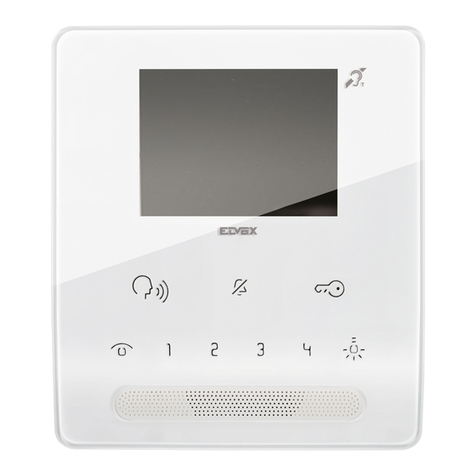
AT&T Door Phone Controller User manual

11/16/92
AT&T
AT&T Door Phone Controller
Installation and Operation Manual

© 1992, AT&T
All Rights Reserved
Printed in U.S.A.
CIC# 999-500-315
0II722050-055
Issue 3, November 1992
NOTICE
Every effort was made to ensure that the information in this manual was complete and accurate at the
time of printing. However, information is subject to change.
COMPATIBILITY
The AT&T Door Phone Controller is recommended for use with any AT&T business telephone system.
It is also intended to be used with the AT&T Door Phone Speaker.
WARRANTY INFORMATION
AT&T provides a limited warranty to this product. Refer to “Warranty Information” in Appendix F.
Partner, Spirit, Merlin, System, Dimension, Horizon, Touch-Tone and Comkey are registered trademarks
of AT&T.
VG
ii

AT&T Door Phone Controller Compatibility Chart
Dedicated Dedicated Station Station
Mode Trunk Trunk Access Access Auto
Loop Ground
Port
Saver
Loop
Start
Trunk
Saver
Loop
Start
Aux. Alert
Ringdown
Start Start (Analog) (Analog)
System (Section 4)
(Section 4) (Section 6)
(Section 3/6) (Section 5)
(Section 5)
see Notes 8,7 see Note 4
DIP
Switches
Home Use
(single line
YES
NO
service)
NO
YES
NO NO
NO
PARTNER
NO YES
see Notes11,12
YES
NO
see Notes 11,12
NO
see Note 11
PARTNER
YES
YES
see Notes 11,12
YES
YES
see Notes 11,12
YES
see Note 13
NO
PLUS see Note 11
Spirit
YES
NO YES
see Notes 4,6
YES NO
see Notes 4,6
NO
308/616, see Note 4
1224/2448
Merlin
YES
YES
YES NO
see Notes 4,5
NO
NO
206/410/820 See Notes 4,5 see Notes 4,5
Merlin II
YES
see Notes 4,5
NO YES
see Notes 4,5,9
YES
YES
see Notes 4,5,9
YES
Merlin
YES
NO YES
see Notes 4,5
YES
NO
see Notes 4,5
NO
Plus see Notes 4,5
Merlin
YES
NO
YES
see Notes 4,5,9
YES
YES
see Notes 4,5,9
YES
1030/3070 see Notes 4,5
System 25
YES
YES
see Notes 1,4
YES
see Notes 2,7
YES
YES
see Notes 2,7 see Note 1
YES
see Not e 1
see Notes 1,4
System 75
NO
NO NO NO NO
YES
see Note 14
System 85
NO
YES
see Note 4
NO NO
YES YES
see Note 14
Dimension
NO YES
see Note 4
NO NO
YES
YES
see Note 14
Horizon
YES
YES
see Note 4
YES
see Notes 4,6,7
YES
YES
see Notes 4,6,7
YES
see Note 14 see Note 4
Comkey
YES
NO
YES
see Note 4
YES NO
see Note 4
NO
see Note 14 see Note 4

Application Notes (for Compatibility Chart)
1.
2.
3.
4.
5.
6.
7.
8.
When used in any mode of a System 25, if the user initi-
ates a call to the door and he wishes to enter the
Option Selection mode, pressing three pound keys fol-
lowed by the digit 3 (i.e., # # # 3, not # # 3) must be
entered. Actually, the first # does not seem to be recog-
nized at any time during the call. However, it should be
noted that only # # 3 is needed to enter the Option Se-
lection mode when the call is initiated from the door
button press.
When sharing a trunk port on a System 25, that port
must be configured as an “805” PBX/Centrex, not an
“801” Loop trunk. This is the only way to transmit a
hook flash to that port.
On the Merlin 1030/3070 tip and ring station application,
there is a preset delay such that the Merlin system will
disregard DTMF for the first 12 seconds of the connec-
tion. In this mode, users have the choice of either
changing that time period or waiting for it to time out for
each call.
In general, the ring-cadence option selection applies
only if there is an auxiliary alert device connected. All
of the EKTS/PBX’s will “absorb” the ringing signal from
the AT&T Door Phone Controller and generate their
own ring cadence to the telephone sets.
When using the AT&T Door Phone Controller in any con-
figuration with a Merlin System, the pound key must be
pressed twice (##) for each pound (#) sent to the unit
when dialing from a multi-button set.
Port Saver/Trunk Saver operation will not work for
Tip/Ring sets. A switch-hook flash is not passed to the
trunk port from these sets.
A trunk shared with the AT&T Door Phone Controller
should not be placed in a trunk pool with other trunks.
When the AT&T Door Phone Controller shares a C.O.
trunk, Trunk Saver operation is recommended.
iv

Application Notes (for Compatibility Chart) continued
9.
10.
11.
12.
13.
14.
Tip/Ring telephone sets connected to the Merlin System
through a BTMI cannot use Port Saver/ Trunk Saver op-
eration. The BTMI wiII not transmit the required
hook-flash signal.
System 75 requires a pound (#) to be dialed at the end
of every dial string. This is required to send the dialed
number to the trunk port.
Tip/Ring telephone sets cannot be used in this mode to
access the AT&T Door Phone.
For PARTNER telephone sets not equipped with a Re-
call button, “FEATURE 03” must be dialed to send a
hook-flash signal to the trunk port.
In the Ringdown mode, no number should be pro-
grammed in the AT&T Door Phone for it to dial when
the door button is pressed. The PARTNER Plus system
should be programmed to alert the desired stations
when the door phone goes off-hook on its station port.
The information for this system is based on engineering
judgment.
v

Contents
1
Introduction
■ Using This
■ Features
■ Terms You
1-1
Manual 1-2
1-3
Should Know 1-5
2
Installation Procedures
■
■
■
■
■
■
■
■
■
■
■
Important Safety Information
General Information
Introduction
Door Phone Controller Back Panel Connections
Prior to Installation
AT&T Door Phone Controller Location
Installation
Connecting Door Speaker, Door
Switch to the AT&T Door Phone
Connecting Power
Button, and
Controller Door Ajar
Operation and Controls Information
Connecting the AT&T Door Phone Controller to
Your Telephone Equipment
2-1
2-3
2-5
2-6
2-6
2-8
2-9
2-11
2-13
2-17
2-20
2-22
3
Installation for Home/Residential 3-1
■ Overview3-2
■ DIP Switch Selections 3-2
■ Installation 3-3
■ Option Selection 3-5
■ Operation – Basic Door Answer Function 3-7
vii

4
Installation for Telephone Systems With Available 4-1
Dedicated Trunk Port
■ Overview
■ DIP Switch Selections
■ Installation
■ Option Selection
■ Operation – Basic Door Answer Function
4-2
4-2
4-3
4-6
4-8
5Installation for Telephone Systems With Available 5-1
Station Port
■ Overview
■ DIP Switch Selections
■ Installation
■ Option Selection
■ Operation
5-2
5-2
5-3
5-5
5-8
6Installation for Telephone Systems Without Available 6-1
Dedicated Trunk or
■ Overview
Station Port
6-2
■ DIP Switch Selections 6-2
■ Installation 6-3
■ Option Selection 6-5
■ Port Saver or Trunk Saver Mode Installation 6-6
■ Operation – Basic Door Answer Function 6-9
7Troubleshooting and Maintenance 7-1
■ Troubleshooting Procedures 7-2
■ Maintenance 7-4
viii

A
DIP Switch Settings A-1
B
Option Selection Mode Definitions B-1
C
Specifications C-1
D
Using the AT&T Door Phone Controller With an D-1
Answering Machine
E
AT&T Auxiliary Alert Option E-1
FFCC Regulations and Warranty F-1
ix

Figures
1
Introduction 1-1
1-1.
Front View of the AT&T Door Phone Controller 1-4
and Control Panel
2
Installation Procedures 2-1
2-1.
2-2.
2-3.
2-4.
2-5.
2-6.
2-7.
2-8.
2-9.
Door Phone Controller Back Panel Connections
Typical AT&T Door Phone Controller Installation
Mounting AT&T Door Phone Controller to Wall
Connections for AT&T Door Phone Speaker,
Door Button and Door Ajar Devices
Connections for Remote Door Open Switch
(optional)
Connections for Electric Door Strike Plate
(optional)
Connections for Auxiliary Alert Device (optional)
Plug the AT&T Door Phone Controller Power Cord
and Transformer to 120 VAC Outlet
Configuration of Telephone Equipment Flow Chart
2-8
2-10
2-12
2-14
2-15
2-16
2-18
2-19
2-22
3Installation-Home/Residential 3-1
3-1. Home/Residential DIP Switch Settings 3-3
3-2. Connecting AT&T Door Phone Controller to 3-4
Standard Telephone Equipment
x

4Installation-Dedicated Trunk Port 4-1
4-1. DIP Switch Setting for PBX with Dedicated Trunk 4-3
Port
4-2a. Connecting Door Phone Controller to Standard 4-4
Telephone Equipment
4-2b. Using Modified Modular Cable for Ground Start 4-5
Installations
5Installation-Dedicated Station Port 5-1
5-1. DIP Switch Configuration for Telephone System 5-3
with Dedicated Station Access, Station Mode
5-2. Connecting the AT&T Door Phone Controller to a 5-4
Telephone System with Dedicated Analog Station
Port
6Installation-No Dedicated Trunk/Station Port 6-1
6-1. DIP Switch Setting for PBX With Shared Trunk Port 6-3
6-2. Connecting The AT&T Door Phone Controller to 6-4
a Telephone System With Shared Trunk Port
DUsing the Door Phone Controller With An Answering D-1
Machine
D-1. Installation Method Used For Answering Only D-2
Telephone Calls
D-2. Installation Method Used For Answering Both Door D-2
and Telephone Calls
EAppendix-Auxiliary Alert Device Connections E-1
E-1. Connections For Auxiliary Alert Device E-3
xi
Table of contents
Other AT&T Intercom System manuals