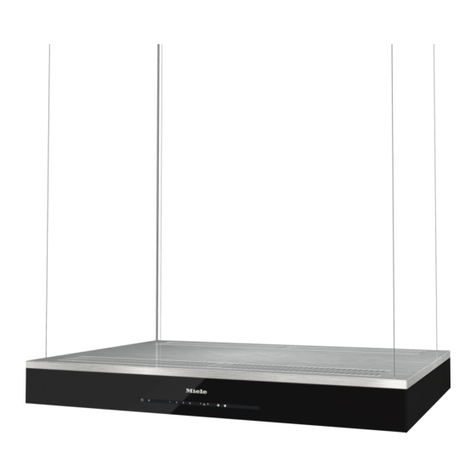
Amica OMP6341I User manual

IO-HOO-0850
(10.2020)
Kitchen extractor hood / okap nadkuchenny /
kuchyňského odsavače / kuchynského odsávača /
tűzhely feletti páraelszívó
OMP6341I
OPERATING INSTRUCTIONS EN
INSTRUKCJA OBSŁUGI PL
NÁVOD K OBSLUZE CS
NÁVOD NA OBSLUHU SK
HASZNÁLATI UTASÍTÁS HU

- 2 -
NOTES ON SAFETY 5
UNPACKING 8
DISPOSAL OF OLD APPLIANCE 8
OPERATION 9
COOKER HOOD CONTROLS 9
OTHER IMPORTANT INFORMATION CONCERNING THE OPERATION OF THE HOOD 10
CLEANING AND MAINTENANCE 11
MAINTENANCE 11
GREASE FILTER 11
ACTIVATED CHARCOAL FILTER 11
LIGHT 11
WARRANTY AND AFTER SALES SERVICE 12
WARRANTY 12
EN- Table of contents
CS- Obsah
PL- Spis treści
WSKAZÓWKI DOTYCZĄCE BEZPIECZEŃSTWA 14
ROZPAKOWANIE 18
USUWANIE ZUŻYTYCH URZĄ DZEŃ 18
OBSŁUGA 19
STEROWANIE OKAPEM 19
INNE WAŻNE INFORMACJE DOTYCZĄCE OBSŁUGI OKAPU 20
CZYSZCZENIE I KONSERWACJA 21
KONSERWACJA 21
FILTR PRZECIWTŁUSZCZOWY 21
FILTR WĘGLOWY 21
OŚWIETLENIE 21
GWARANCJA, OBSŁUGA POSPRZEDAŻOWA 22
GWARANCJA 22
BEZPEČNOSTNÍ POKYNY 24
VYBALENÍ 27
LIKVIDACE OPOTŘEBOVANÝCH ZAŘÍZENÍ 27
OBSLUHA 28
OVLÁDÁNÍ ODSAVAČE 28
JINÉ DŮLEŽITÉ INFORMACE O OBSLUZE ODSAVAČE 29
ČIŠTĚNÍ A ÚDRŽBA 30
ÚDRŽBA 30
PROTITUKOVÝ FILTR 30
UHLÍKOVÝ FILTR 30
OSVĚTLENÍ 30
ZÁRUKA, POPRODEJNÍ SERVIS 31
ZÁRUKA 31

- 3 -
SK- Obsah
HU - Tartalomjegyzék
BEZPEČNOSTNÉ POKYNY POUŽÍVANIA 33
ROZBALENIE 37
LIKVIDÁCIA ZARIADENÍ 37
POUŽÍVANIE 38
OVLÁDANIE ODSÁVAČA 38
INÉ DÔLEŽITÉ INFORMÁCIE TÝKAJÚCE SA POUŽÍVANIA ODSÁVAČA 39
ČISTENIE A ÚDRŽBA 40
KONZERVÁCIA 40
PROTITUKOVÝ FILTER 40
UHLÍKOVÝ FILTER 40
OSVETLENIE 40
ZÁRUKA, POPREDAJNÝ SERVIS 41
ZÁRUKA 41
BIZTONSÁGI UTASÍTÁSOK 43
KICSOMAGOLÁS 47
A HASZNÁLT KÉSZÜLÉKEK ELTÁVOLÍTÁSA 47
HASZNÁLAT 48
PÁRAELSZÍVÓ VEZÉRLÉSE 48
A PÁRAELSZÍVÓ MŰKÖDÉSÉVEL KAPCSOLATOS EGYÉB FONTOS INFORMÁCIÓK 49
TISZTÍTÁS ÉS KARBANTARTÁS 50
KARBANTARTÁS 50
ZSÍRSZŰRŐ 50
SZÉNSZŰRŐ 50
VILÁGÍTÁS 50
GARANCIA ÉS VÁSÁRLÁS UTÁNI SZERVIZ 51
GARANCIA 51

- 4 -
Dear customer,
From now on, your daily housework will be easier
than ever before. Your appliance is excepon-
ally easy to use and extremely ecient. Aer reading
these Operang Instrucons, operang the appliance
will be easy.
Before being packaged and leaving the manufacturer,
the appliance was thoroughly checked with regard to
safety and funconality.
Before using the appliance, please carefully read
these Operang Instrucons. By following these
instrucons carefully you will be able to avoid any
problems in using the appliance. It is important to
keep these Operang Instrucons and store them in a
safe place so that they can be consulted at any me.
Follow these instrucons carefully in order to avoid
possible accidents.
Sincerely,

- 5 -
NOTES ON SAFETY
• Before using the appliance, please carefully read
this manual!
• The appliance is designed for household use only.
• The manufacturer reserves the right to introduce
changes, which do not aect operation of the ap-
pliance.
• The manufacturer shall not be liable for any dam-
age or re caused by the appliance resulting from
failure to follow instructions in this manual.
• Cooker hood is designed to remove cooking
odours. Do not use cooker hood for other pur-
poses.
• Connect the cooker hood operating in extraction
mode to a suitable ventilation duct (do NOT con-
nect the cooker to smoke or ue gas ducts, which
are in use). It requires installation of the air ex-
traction duct to the outside. The length of the
duct (usually a pipe of Ø 120 or 150 mm) should
not be longer than 4-5 m. An air extraction duct
is also required for telescopic and furniture hoods
in absorption mode.
• Cooker hood operating in air recirculation mode
requires the installation of an activated charcoal
lter. In this case, installing an extractor duct is
not required, however it is recommended to in-
stall an air guide vane (Mainly in chimney cooker
hoods).
• The cooker hood features independent lighting
and exhaust fan that can be operated at one of
several speeds.
• Depending on the type, the hood is designed to
be permanently attached to a vertical wall over
a gas or electric stove (chimney and universal
hoods); on the ceiling over a gas or electric stove
(island hoods); on the vertical built in furniture
over a gas or electric stove (telescopic and built-
in hoods). Before installing, make sure that the

- 6 -
wall/ceiling structure is strong enough to suspend
the hood. Some hoods are very heavy.
• For details of the installation distance above an
electric hob please refer to product technical
sheet If the installation instructions of the gas
cooker specify a greater distance, this must be
taken into account (Fig. 1).
• Do not leave an open ame under the hood.
When the pots are removed from the burner, set
the minimum ame. Always make sure that the
ame does not extend outside the pot, because it
causes unwanted loss of energy and a dangerous
concentration of heat.
• When cooking on fat, supervise the pans con-
stantly, because overheated fat can ignite.
• Unplug the appliance before any cleaning, replac-
ing the lter or repair work.
• Cooker hood grease lter should be cleaned at
least once a month, because the lter saturated
with fat is ammable.
• Ensure adequate ventilation (air ow) if other
equipment such as liquid fuel stoves or heaters
are operated in the room in addition the cooker
hood. When the cooker hood is simultaneously
operated with burning appliances requiring ade-
quate fresh air from the room to work properly,
their safe operation is possible if under pressure
around these appliances is a maximum of 0.004
mbar (this does not apply when the cooker hood
is used as an odour lter)
• Do not lean on the hood.
• The hood should be cleaned regularly both inside
and out (AT LEAST ONCE A MONTH, following the
indications concerning maintenance provided in
this manual)..Failure to adhere to the rules con-
cerning cleaning the hood and replacing lters
results in a re risk.
• If the power cord is damaged it should be re-
placed by a specialised service centre.
• Ensure that it is possible to disconnect the ap-

- 7 -
pliance from the mains by removing the plug or
switching o the bi-polar switch.
• This appliance is not intended for use by persons
(including children) with physical, mental or sen-
sory handicaps, or by persons inexperienced or
unfamiliar with the appliance, unless under su-
pervision or in accordance with the instructions
as communicated to them by persons responsible
for their safety.
• Particular attention should be paid not to allow
unaccompanied children to use the appliance.
• Make sure voltage indicated on the nameplate
corresponds to the local mains supply voltage.
• Before use, extend and straighten the power cord.
• Packaging materials (bags, polyethylene, poly-
styrene, etc.) should be kept away from children
during unpacking.
• Before connecting the hood to the mains power
supply always check that the power cord is prop-
erly installed and is not trapped by the appliance.
Do not connect the appliance to the mains until
assembly is complete.
• Do not operate your kitchen hood without the al-
uminium grease lters.
• It is strictly forbidden to cook dishes under on an
open ame (ambé) under your kitchen hood.
• Always strictly adhere to regulations issued by the
competent local authorities regarding the techni-
cal and safety requirements for fume extraction.
• Failing to tighten bolts and fasteners in accord-
ance with these instructions may endanger life
and health.
• Hanging kitchen hoods operate only in air circu-
lation / odour absorber mode
• WARNING! Failure to install the screws or xing
device in accordance with these instructions may
result in electrical hazards.

- 8 -
UNPACKING
During transportation, protective
packaging was used to protect the
appliance against any damage. Af-
ter unpacking, please dispose of all
elements of packaging in a way that
will not cause damage to the environ-
ment.
All materials used for packaging the
appliance are environmentally friendly; they are
100% recyclable and are marked with the appropri-
ate symbol.
Important! Packaging materials (bags, polyethyl-
ene, polystyrene, etc.) should be kept away from
children during unpacking.
DISPOSAL OF OLD APPLIANCE
In accordance with European Directive
2012/19/EU and local legislation re-
garding used electrical and electronic
goods, this appliance is marked with
the symbol of the crossed-out waste
container. This marking indicates that
the appliance must not be disposed of
together with other household waste
after it has been used.
The user is obliged to hand it over to waste collec-
tion centre collecting used electrical and electron-
ic goods. The collectors, including local collection
points, shops and local authority departments pro-
vide recycling schemes.
Proper handling of used electrical and electronic
goods helps avoid environmental and health haz-
ards resulting from the presence of dangerous com-
ponents and the inappropriate storage and process-
ing of such goods.

- 9 -
OPERATION
Cooker hood controls
Control Panel is shown in Figure 4, for reference it is also shown below:
3
2
1
4
The control panel is equipped with buttons.
To turn on the kitchen hood, press one of the buttons to select the de-
sired speed:
1- Low speed. Use this speed when cooking a little food with hardly any
fumes.
2- Medium speed. Use this speed when cooking multiple dishes at the
same time with moderate amount of fumes.
3- High speed. Use this speed when frying or grilling, with large
amount of fumes.
4- Turn light on/o

- 10 -
Other important information concerning the operation of
the hood
Operation in air circulation / odour lter mode. In this mode, the ltered
air returns to the room through the outlets. Install activated charcoal
lter in this setting. It is recommended to install the air guide (available
depending on the model, mainly in chimney cooker hoods).
Air extraction operation: When cooker hood operates in extraction mode,
air is discharged outside through an extraction duct. Remove activated
charcoal lter in this setting. The cooker hood is connected to the air
outlet opening using a rigid or exible extraction duct with a diameter of
150 or 120 mm, and the appropriate clamps, which must be purchased
at a hardware store. The appliance should be installed by a qualied
installer.
Fan speed: Lowest and medium fan speed is used in normal conditions
and less intense odours, while the highest speed is used only when cook-
ing odours are very intense, such as during frying or grilling.
Note (applies to universal hoods only): Due to the design of universal
hoods you need to manually change the mode of operation. See Figure
8 for instructions on how to change the mode.
Note (only applies to telescopic and in-built kitchen hoods): Furniture
and telescopic cooker hoods operating in air recirculation mode require
installation of the exhaust duct. The other end of the duct should be di-
rected to the room as it will discharge ltered air.
Note: Hanging kitchen hoods operate only in air circulation / odour ab-
sorber mode
Table of contents
Languages:
Other Amica Ventilation Hood manuals

Amica
Amica OKC4441BO User manual

Amica
Amica OKC620SB User manual

Amica
Amica KH 694 616 SM User manual

Amica
Amica KH 17106 E User manual

Amica
Amica FH 664 300 S User manual

Amica
Amica KH 17196 E User manual

Amica
Amica OTP6241W User manual

Amica
Amica OWC4441BK User manual

Amica
Amica OKM6652IS User manual

Amica
Amica OKP531G User manual

Amica
Amica OKP6552SB User manual

Amica
Amica OKC656SW User manual

Amica
Amica OTP6241I/ST 62 AX User manual

Amica
Amica OKC954T User manual

Amica
Amica OTP9651BG User manual

Amica
Amica OKC951S User manual

Amica
Amica KH 694 616 E User manual

Amica
Amica ST 63 CW User manual

Amica
Amica SKZ 62BB User manual

Amica
Amica OKP6654IS User manual