Amica FK2623F Quick start guide

www.amica-international.co.uk
FK2623F
Fridge Freezer
Installation, use and maintenance

2
Contents:
3 Important information
4 Before first use
5 Important safety notes
6 Important notes on use of the fridge
7 Important notes on use of the freezer
8 Important notes on first use and general usage
9 Fridge layout and storage
10 Setting the temperature
11 Defrosting the fridge
12 Defrosting the freezer
12 Care and cleaning
13 Changing the light bulb
14 Troubleshooting
16 Fridge noise
16 Installation and ventilation
17 Appliance dimensions
18 Electrical information
19 Energy eciency information
Please note: Your freezer section
has a load line, marked by a
vertical line and two arrows,
which you should avoid passing
when storing goods. Keeping
this small gap between the load
line and the door will maximise
eciency and performance of the
appliance.

3
Important
Amica cannot be held responsible for injuries or losses caused by
incorrect use or installation of this product. Please note that Amica
reserve the right to invalidate the guarantee supplied with this product
following incorrect installation or misuse of the appliance.
Under no circumstances should any external covers be removed for
servicing or maintenance except by suitably qualified personnel.
Do not use the appliance if the plug, the mains cord or the
appliance itself is damaged. If the mains cord is damaged, you
must have it replaced by the manufacturer, or an authorised
service centre or similarly qualified person in order to avoid a
hazard.
Appliance information:
Please enter the details on the appliance rating plate below for
reference, to assist Amica Customer Care in the event of a fault with
your appliance and to register your appliance for guarantee purposes.
Appliance Model
Serial Number
EU Declarations of Conformity:
This appliance meets the requirements of all applicable EU directives
with the corresponding harmonised standards which provide for CE
marking.
WARNING: Risk of fire/flammable materials

4
IMPORTANT INFORMATION FOR CORRECT DISPOSAL OF THE
PRODUCT IN ACCORDANCE WITH WEEE DIRECTIVE 2012/19/EU.
At the end of its working life, the product must not be disposed
of as urban waste. It must be taken to a special local authority
dierentiated waste collection centre or to a dealer providing this
service.
Disposing of a household appliance separately avoids possible
negative consequences for the environment and health deriving from
inappropriate disposal and enables the constituent materials to be
recovered to obtain significant savings in energy and resources. As a
reminder of the need to dispose of household appliances separately,
the product is marked with a crossed-out wheeled dustbin .
Before first use of the fridge/freezer
You must allow the fridge to settle for at least five hours prior to
switching the power on.
It is recommended that you clean the interior of the appliance prior to
first use, using a solution of bicarbonate of soda and warm water then
thoroughly dry the interior.
The fridge may have an odour to it at first use. This will disappear
as the appliance cools.
This appliance has been designed with ease of use in mind but
please read the following instructions carefully to ensure you
familiarise yourself with the appliance and its operation. This will help
you to get the best results and also help to prevent you from being
charged for unnecessary service calls.

5
Important
This appliance is not intended for use by persons (including children)
with reduced physical, sensory or mental capabilities, or lack of
experience and knowledge, unless they have been given
supervision or instruction concerning use of the appliance by a person
responsible for their safety.
•Children must not play with the appliance.
•Cleaning and user maintenance must not be made by children
without supervision.
•If the appliance is switched o, you should allow five minutes
before switching it on again to prevent unnecessary damage to
the compressor.
•WARNING - Keep ventilation openings clear of obstruction.
•WARNING - Do not use mechanical devices or other means to
accelerate defrosting processes.
•WARNING - Do not use electrical appliances inside the food
storage compartments of the appliance.
•WARNING - Do not damage the refrigerant circuit.
•WARNING - Do not store explosive substances such as aerosol
cans, with a flammable propellant, within this appliance.
•Children should be supervised to ensure that they do not play with
the appliance.
•This appliance is not intended for use at altitudes exceeding 2000
metres.
•This appliance is a household refrigerator and is intended to be
used in domestic environments and similar applications such as
sta kitchen areas, farm houses and bed and breakfast type envi-
ronments. It should not be used in commercial environments.
•If your appliance uses R600a as a refrigerant (this information will

6
will be provided on the rating plate) you must take care during
transportation and installation to prevent the cooling system ele-
ments from being damaged. R600a is an environmentally friendly
and natural gas, but is explosive. In the event of a leak due to
damage to the cooling system, move your fridge away from open
flames or heat sources and ventilate the room in which the appli-
ance is located for 5 minutes.
Fridge use
•Never put liquids in the refrigerator uncovered.
•Never put hot foods in the refrigerator. Warm food should
be allowed to cool to room temperature before being put
into the refrigerator.
•Nothing should rest against the rear wall of the
refrigerator, as this will cause frost and possible
condensation problems which will be dicult to remove.
•Make sure food is clean and any extra water is wiped
away before putting into the fridge.
•Wrap or cover food before putting into the fridge. This will
help prevent the loss of moisture, keep food fresh and
avoid unpleasant odours.
• Sort foods prior to storing. Any foods to be used soon
should be stored at the front of the shelf to prevent
deterioration caused by the door being open for
prolonged periods.
•Do not overfill the fridge. There should be sucient
space between the foods to allow the cool air to circulate.

7
•Thawing frozen foods in the fridge compartment will help
to keep the temperature low and save energy.
•Never store raw meats above cooked meats or other
produce. This will help to prevent juices from raw meat
contaminating other foodstus. We recommend storing
raw meat packages or containers on kitchen roll and
changing the roll regularly. This will help to stop raw
meat juices running around the appliance.
Freezer use
•The freezer compartments are designed to store only
frozen food.
•Never put hot or warm foods in the freezer, allow them to
cool fully before putting them into the freezer.
• Follow the instructions on the food packaging for storage
of frozen food. If no information is provided, foods should
not be stored for more than three months after the
purchase date.
•Store food in small packages (ideally less than 2kg). This
reduces the freezing time and improves the quality of the
food after thawing.
•Wrap food before putting into the freezer. To stop the
wrapping sticking together, ensure it is dry.
• Label the food before freezing with information including
type of food and dates of storage and expiry.
•Once food is thawed, it must not be refrozen. Only
defrost as much food as is required to prevent wastage.

8
• Bottled or canned drinks should not be stored in the
freezer compartments as they could explode.
•The maximum amount of fresh food that can be frozen
within a 24 hour period is 8 kg.
•Do not attempt to freeze more than the maximum
amount.
•To freeze fresh food more quickly, switch the thermostat
to setting 5 a few hours prior to placing the food in the
freezer. After the food is frozen, lower the setting.
• Where possible, do not overload your fridge and freezer
compartments. This allows for air circulation around the
contents and keeping airways etc. as unobstructed as
possible will ensure optimum performance.
Important notes on first use and usage
•When you first switch on the appliance, you should ideally run
it without any contents for the first 24 hours and not open the
appliance doors. If you need to use it straight away, try not to put a
large quantity of food inside.
•The appliance will work continuously until it comes down to the
correct temperature.
•This appliance features a five minute delay function which, after
power has been cut and restored or the appliance turned o and
on again, allows five minutes to pass before switching the cooling
system on again. This is to prevent unnecessary damage to the
compressor.
•The climate class for this appliance is ST/N. This means ambient
temperatures should not fall below 16°C or exceed 38°C.

9
Fridge layout and storage
1 - Thermostat dial and light 8 - Freezer bottom basket
2 - Fridge shelves 9 - Fridge compartment
3 - Crisper cover 10 - Door shelves
4 - Crisper 11 - Bottle shelf
5 - Freezer flap 12 - Freezer compartment
6 - Freezer upper basket
7 - Freezer middle basket
Fig. 1
1
2
3
4
5
6
7
8
9
10
11
12
10
Food types and where to store them within the fridge section:
Vegetables and fruits - Crisper drawer
Red meat - Fridge shelves (lower)
White meat & fish - Fridge shelves (lower)
Cheese - Door shelves (upper)
Butter and margarine - Door shelves (upper)
Bottled milk products and yoghurt - Bottle shelf
Cooked food - Fridge shelves (upper)
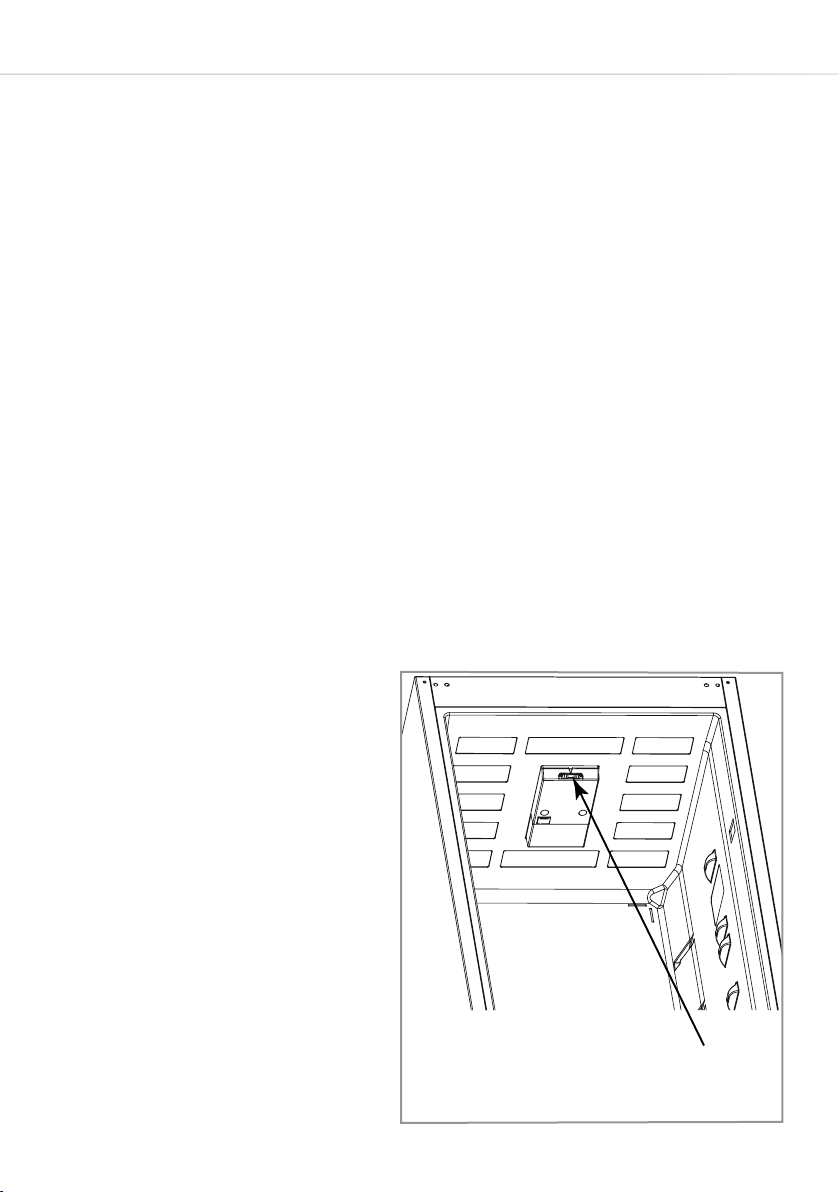
Setting the temperature
To adjust the temperature turn the thermostat control knob from left
to right to the required level. This ranges from 1 to 5. The temperature
becomes colder the higher the number on the control.
We recommend initially setting the temperature control in mid range
for the first 24 hours then
adjusting the temperature up
or down from this point as your
personal preference. If your
fridge is often relatively empty,
set the thermostat to a low
number to help prevent straining
the system.
The climate class for this
appliance means ambient
temperatures should not fall
below 16°C nor exceed 38°C.
Thermostat
location
Fig. 2
Table of contents
Other Amica Freezer manuals

Amica
Amica GSN 327 020 E User manual

Amica
Amica UZ130.3 User manual

Amica
Amica FZ206.4E User manual

Amica
Amica GSN 327 010 E User manual

Amica
Amica BZ2263 User manual

Amica
Amica FZ096.4 User manual

Amica
Amica FS300.3 User manual

Amica
Amica UZ130.3 User manual

Amica
Amica GS 15467 W User manual

Amica
Amica DT 374 166 Series User manual

Amica
Amica FZ136.3 AA User manual

Amica
Amica BZ130.3 User manual

Amica
Amica FZ042.4AA User manual

Amica
Amica FZ041.3 User manual

Amica
Amica FZ206.3 User manual

Amica
Amica FK2623 Specification sheet

Amica
Amica FZ1334 User manual

Amica
Amica AB6201 User manual

Amica
Amica FZ2916.3DFX User manual

Amica
Amica GT 315 100 W User manual