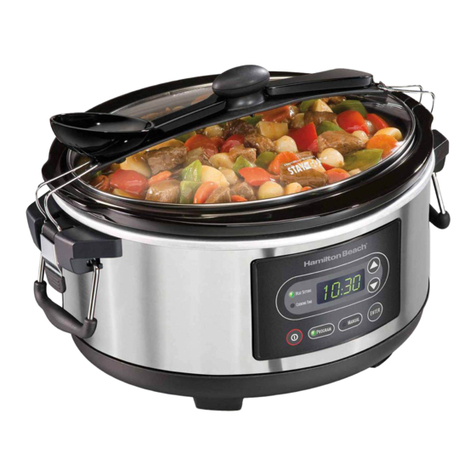
Alpina BSJ40-B2B User manual

ITEM: 871125218170
MODEL: BSJ40-B2B
220-240V 50/60HZ 240W
A.I.&E. Adriaan Mulderweg 9-11
5657 EM Eindhoven, The Netherlands
Edco UK Ltd, 1st Floor Two Chamberlain Square
B3 3AX, Birmingham, UK
Instrucon manual
Bedienungsanleitung
Manuel d’ulisaon
Gebruiksaanwijzing
UK: Slow Cooker
DE: Schongarer
FR: Mijoteuse
NL: Slowcooker
[UK] Please read the instructions carefully and save the instructions for future use.
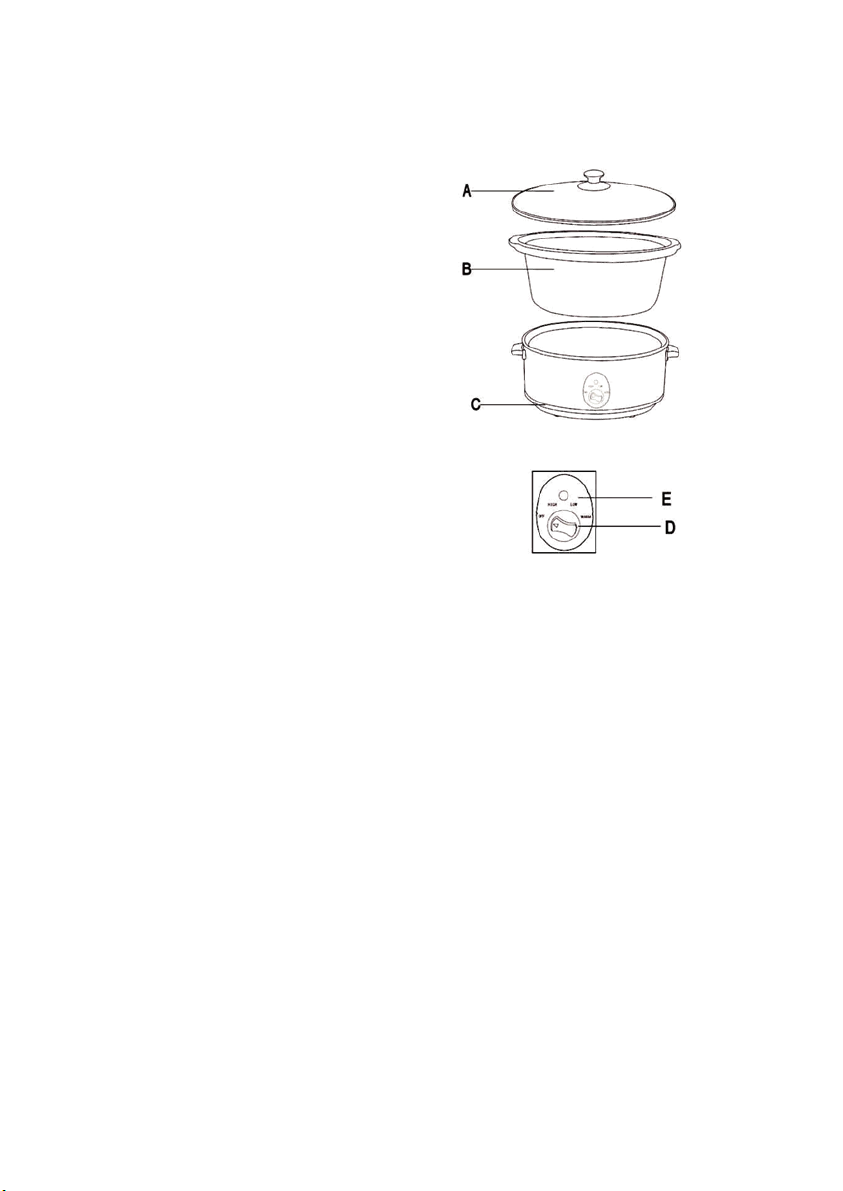
PARTS
A. Glass Lid
B. Ceramic Pot
C. Base
D. Control Knob
E. Power Indicator
SAFETY PRECAUTIONS
When using electrical appliances basic safety precautions should
always be followed including:
1. Read all the instructions.
2. If the supply cord is damaged, it must be replaced by the
manufacturer, its service agent or similarly qualified
persons in order to avoid a hazard.
3. Do not let the power cable hang over the edge of a table
or counter and do not let it come into contact with any hot
surfaces.
4. Do not carry the appliance by the power cable.
5. Do not use any extension cable with this appliance.
6. Do not pull the plug out by the cable as this may damage
the plug and/or the cable.
7. When the appliance is not in use and before cleaning it,
switch the appliance off at the mains socket then remove
the plug from the socket.
8. Switch off and unplug the appliance before fitting or
removing tools/attachments, after using it and before
cleaning it.
9. Close supervision is necessary when any appliance is
used by or near children.
10. Children must not play with the appliance.

11. This appliance can be used by children aged 8 years and
above and persons with reduced physical, sensory or
mental capabilities or a lack of experience and knowledge
if they have been given supervision or instruction
concerning use of the appliance in a safe way and
understand the hazards involved.
12. Cleaning and user maintenance shall not be made by
children unless they are older than 8 and supervised.
13. Take care when any appliance is used near pets.
14. Do not use this product for anything other than its intended
use.
15. This appliance is for household use only.
16. Please ensure that the appliance is used on a stable,
level, and heat resistant surface.
17. Do not immerse cables, plugs or any part of the appliance
in water or any other liquid.
18. Do not use the appliance outdoors.
19. Do not use the appliance on a gas or electric cooking top
or over or near an open flame.
IMPORTANT: Do not use this product in conjunction with
automatic timers.
20. Never attempt to move or clean this product until it has
completely cooled.
21. Do not touch hot surfaces. Use handles or knobs.
22. Extreme caution must be used when moving an appliance
containing hot oil or other hot liquids.
CAUTION: The Slow Cooker is very heavy. To avoid injury
to persons or damage to property or the appliance,
NEVER attempt to lift or move the appliance with full
ceramic cooking pots in place. Place the base of the Slow
Cooker in the desired location first. Then place the
ceramic cooking pots into the base.
23. Never use any removable ceramic cooking pots on any
gas or electric cooker tops or on an open flame.
24. Avoid sudden temperature changes, such as adding
refrigerated food to a heated pot.
25. To reduce the risk of electric shock, cook only in the
removable cooking pots.
26. Use extreme caution when removing a hot container with
food in it.

27. When uncovering a pot, carefully tilt the lid so that the
opening is away from you to avoid scalding and allow
water to drip into the pot.
28. To disconnect the appliance, turn all 3 temperature
controls to the OFF position, then remove the plug from
the mains socket.
29. Do not use a cracked container. Do not place a hot
container on a wet or cold surface.
30. Unplug the appliance from the mains socket when it is not
in use and before cleaning it. Allow the appliance to cool
before attaching or removing parts and before cleaning the
appliance.
CAUTION: Wear oven mitts when handling the slow
cooker as the surface may be extremely hot!
CAUTION: While the appliance is in use, hot steam may
rise from the cooking pots. Be careful when handling.
CAUTION! DO NOT use the KEEP WARM setting to cook
food. DO NOT keep the slow cooker on this setting for
more than 4 hours.
IMPORTANT: If you forget to switch your slow cooker on
or accidentally put uncooked ingredients on the KEEP
WARM setting, you must throw away your ingredients and
start again. Any food that sits at a temperature below 60°C
can harbour bacteria.
31. The heating element surface is subject to residual heat
after use.
32. This appliance is for household use only and similar
applications, such as:
- Staff kitchen areas in shops, offices and other
working environments
- Farm houses
- By clients in hotels, motels and other residential
type environments
- Bed and breakfast type environments
33. Keep the appliance and its cord out of reach of children
aged less than 8 years.

Before First Use
Read all instructions and safety information carefully before first
use. Please retain this information for future reference.
1. Carefully unpack and remove the parts from the
packaging.
2. Place the Slow Cooker on a flat, dry surface.
3. Remove any promotional labels or stickers.
4. Remove the ceramic cooking pots and glass lids.
5. Wash the cooking pots and glass lids in hot, soapy water
with a mild household detergent.
6. Rinse and dry thoroughly.
7. DO NOT immerse the appliance, its power cable or plug in
water or any other liquid.
8. Do not use harsh abrasives or chemicals.
9. Dispose of the packaging in a responsible manner.
10. Wipe the exterior of the slow cooker heating base with a
clean, damp cloth.
11. Your appliance is now ready for normal use.
Using the Appliance
Self-Centring Guides
1. Place the base of the Slow Cooker on a flat, dry, heat-
resistant surface.
2. Place your prepared ingredients into a cooking pot and
cover the pot with a glass lid. Ensure the lid is centred. Fill
the pot to between 1/2 and 3/4 of its capacity to avoid over
or under-cooking. Do not overfill the cooking pot. Note:
Repeat these steps if you are cooking in more than one
pot.
3. Plug the slow cooker into the mains socket.
CAUTION! Make sure all of the temperature controls are
set to the OFF position before plugging in the appliance.
4. Select the desired temperature by turning the temperature
control to the required setting: LOW, HIGH or WARM.
5. When cooking is complete, turn the temperature control to
the KEEP WARM or OFF position. Switch off at the mains
socket if you are turning the appliance off.
CAUTION! DO NOT use the KEEP WARM setting to cook
food. DO NOT keep the slow cooker on this setting for
more than 4 hours.
6. Carefully remove the cooking pot from the slow-cooker
base.

CAUTION! ALWAYS wear oven gloves when handling the
slow cooker’s hot surfaces, including the cooking pots and
glass lids.
7. Note: When removing the glass lid, tilt it so that the
opening faces away from you to avoid being burnt by
steam.
8. Do not place the heated cooking pot on any surfaces
affected by heat. Use a hot pad or trivet to protect any
surfaces. Take extra care when moving a cooking pot
containing hot liquid.
9. Unplug the slow cooker from the mains and allow the
appliance enough time to cool completely before cleaning
and storing it.
Note: Always cook with the glass lids on and follow
recommended cooking times.
Temperature Control Settings
Note: Do not use frozen meat. Thaw meat before slow cooking.
LOW: The LOW heat setting gently simmers food for an extended period of time
without overcooking or burning. No stirring is required when using this setting. Ideal for
vegetable dishes and reheating.
Note: When using the LOW setting to cook meat dishes, the meat should be browned
first.
Tip: 1 hour of cooking on HIGH equals 2 to 2 ½ hours on LOW.
HIGH: The HIGH heat setting is ideal for use when cooking dried beans and pulses.
The HIGH setting cooks food in half the time required for the LOW heat setting.
Because food will boil when cooked on the HIGH heat setting, it may be necessary to
add extra liquid, depending on the recipe and the amount of time for which it is cooked.
Occasional stirring of stews and casseroles will improve the flavour distribution.
Monitor food more regularly when cooking on the HIGH setting.
Tips: It is recommended that you use the HIGH setting when you need to cook a tender
cut of meat quickly. Use the LOW setting for tougher cuts – cooking them for longer
allows more time for the meat to grow tender.
KEEP WARM: The KEEP WARM function allows you to keep the food in your slow
cooker warm and ready to eat, even after cooking. Turn the dial
on the front of your slow cooker to KEEP WARM once cooking has finished.
CAUTION! Never use the KEEP WARM setting for more than 4 hours. CAUTION! Do
not use the KEEP WARM setting to cook food.
Slow-Cooking Guide
Because most food is cooked over a period of 6-9 hours, it can be prepared in advance
the evening before and refrigerated in the removable crock pot overnight, then placed
in the slow cooker and switched on in the morning and left to cook all day.

When you arrive home, a delicious, hot meal will await you. The guide below will help
simplify the process of slow cooking, allowing you to obtain ultimate satisfaction from
your slow cooker.
Traditional Recipe Time
Slow Cooker on LOW
Slow Cooker on HIGH
15 – 30 minutes
4 – 6 hours
1 ½ – 2 hours
35 – 45 minutes
6 – 10 hours
3 – 4 hours
50 minutes – 3 hours
8 – 18 hours
4 – 6 hours
Note: These times are approximate. Times can vary depending on the ingredients and
quantities in recipes.
Note: Most uncooked meat and vegetable combinations will require at least 8 hours on
LOW.
Timings
Always allow sufficient time for the food to cook.
It is almost impossible to overcook in the slow cooker, particularly when using the LOW
or WARM setting. Most recipes can be cooked on any one of the temperature settings;
however, the cooking times will vary accordingly. Each recipe will give specific
instructions, indicating the appropriate temperature setting and the suggested cooking
time.
Adapting cooking times for traditional recipes:
Your favourite traditional recipes can be adapted easily by halving the amount of liquid
and increasing the cooking time considerably.
General tips for slow cooking:
1. Do not pre-heat the slow cooker before adding ingredients.
2. For best results, the Slow Cooker should be filled at least halfway.
3. Do not fill the cooking pots to more than three-quarters of their capacity. Note:
Do not overfill the appliance or it will not cook as well as it should.
4. Spray the inside of the cooking pots with non-stick cooking spray for easy
cleaning.
5. The removable ceramic cooking pots are ovenproof and microwave safe.
6. Do not use the removable ceramic cooking pots on gas burners or electric
rings or under a grill (broiler).
7. Do not use the lids in a microwave or oven.
8. Frozen foods such as vegetables and shrimp may be used as part of a
specific recipe.

9. If there is a loss of power while slow cooking, the food being cooked may be
unsafe to eat. If you are unable to determine how long the power was out, we
suggest that the food in the slow cooker be discarded.
10. Use fresh or dried herbs instead of ground; they keep more of their flavour
during long cooking times.
11. Cover all food with a liquid, sauce or gravy. Prepare it in a separate pan, then
add it to the slow cooker, completely covering the food in the cooking pot.
12. Prepare everything you need for your slow-cooked meal the night before if
you will not have time in the morning.
13. Your ingredients should ideally be added to the slow cooker at room
temperature, so take everything out of the fridge 20 minutes before you will
be putting it in the slow cooker.
14. Dairy products such as milk and cheese should be added last, unless your
recipe states otherwise. They break down in the slow cooker, so make sure
you stir them in during the last 15 minutes of cooking.
15. To thicken the tasty juices produced during slow cooking, remove 1 cup (250
ml) of the juices from the Slow Cooker. Place the juices in a small saucepan.
Combine 1 tablespoon (15 ml) of water and 1 tablespoon (15 ml) of corn-
starch. Stir the mixture into the saucepan of juices. Cook and stir the juices
over a medium heat until they boil. Boil and stir them for 1 - 2 minutes or until
slightly thickened.
16. When cooking soups or stews, leave a 2-inch (5 cm) space between the top
of the removable cooking pot and the food so that the dish can come to a
simmer. If cooking a soup or stew on HIGH, check its progress regularly as
some soups will reach a boil on HIGH.
17. Pasta and seafood should be added towards the end of the cooking time.
18. Don’t lift the lid of the slow cooker until you need to. Removing the lid affects
the end result and will actually increase the required cooking time. Only
remove it when you need to add an ingredient.
19. If you are adapting a recipe for your slow cooker, decrease the amount of
liquid you would normally use in the dish by as much as half.
20. All food should be cooked with the glass lid in place. Each time the lid is lifted,
both the heat and the moisture are diminished. Cooking times should be
adjusted to allow for this factor.
21. Slow-cooker recipes:
22. You can also adjust slow-cooker recipes depending on the amount of time
you have. If you wish to decrease the cooking time, cook on HIGH; if you
wish to extend the cooking time, cook on LOW. E.g. if the recipe says to cook
on LOW for 6 – 8 hours and you want a shorter cooking time, set your slow
cooker to HIGH and cook for 3 – 4 hours.

For the suggested cooking times when adjusting a slow cooker recipe, see the guide
that follows:
Cook on LOW
Cook on HIGH
6 – 8 hours
3 – 4 hours
8 – 10 hours
5 – 6 hours
10 – 12 hours
7 – 8 hours
Note: These times are approximate. Times can vary depending on the ingredients and
quantities in recipes.
Liquid amounts
When food is cooking in your slow cooker, very little moisture boils away. To
compensate for this, it is advisable to halve the liquid content of traditional recipes.
Stirring the food
Little or no stirring is required when using the LOW or WARM setting. When using the
HIGH heat setting, stir regularly to ensure even flavour distribution.
Suitable foods Vegetables
•Vegetables cook slowly. Keep pieces small to medium in size and place them
in the bottom of the cooking pot.
•Vegetables can be peeled and cut the night before slow cooking. Cover and
refrigerate them in a separate container. Do not place them in the cooking pot
until you are ready to cook them.
•Cut all root vegetables into small, evenly sized pieces to ensure even cooking.
Root vegetables take longer to cook than meat.
•Gently sauté root vegetables for 2 - 3 minutes before slow cooking. Place
them at the bottom of the pot and make sure all ingredients are fully immersed
in the cooking liquid.
•Boil and soak uncooked red beans for at least 10 minutes before adding them
to your slow cooker. This helps to remove any toxins.
•Pumpkins and other squash vegetables do not need to be cooked in as much
liquid as other slow-cooked vegetables.
•Cut green peppers into small pieces and add them to the slow cooker near the
end of the cooking time as they will become bitter if they are cooked for long
periods.
•Frozen vegetables should always be slightly defrosted before being added to
your slow cooker. They will not take as long to cook as fresh vegetables as
they are generally pre-cooked to some degree.

•The same applies to canned vegetables. When using canned vegetables,
make sure you wash them to remove any excess salt and preservatives
before adding them to your slow cooker. Always drain canned vegetables
before use, so that you do not add extra liquid to your dish.
•Onions are a very popular ingredient in slow-cooker recipes. Slow cooking
does decrease the flavour of onions somewhat, so make sure you add a little
more than you usually would – especially if you are cooking for more than four
hours.
Meat
•Trim all excess fat and sinew from meat before slow cooking, as the slow
cooking method does not allow fat to evaporate.
•Browning meat before adding it to the slow cooker brings extra flavour to the
finished dish. Note: Browning minced meat, such as minced beef or minced
turkey, before placing it in the slow cooker removes excess fat and reduces
the risk of food-borne illnesses.
•Meats can be browned and/or cut up the night before slow cooking. Cover and
refrigerate them in a separate container. Do not place meat in the cooking pot
until you are ready to cook it.
•Whole poultry, such as chicken and Cornish hens, should not be cooked in
the slow cooker because safe cooking temperatures near the bone CANNOT
be reached quickly enough. ALWAYS ENSURE THAT ALL MEAT
PRODUCTS ARE COOKED TO APPROPRIATE INTERNAL
TEMPERATURES.
•Always insert a meat thermometer into roast joints, hams, chicken and other
meats to ensure they are cooked to the desired temperature.
•If you want a thicker sauce for your dish, try dredging the meat in flour before
browning.
•You can use whatever meat you choose in your slow cooker, but slow cooking
is a perfect way to use those cheaper cuts of meat.
•Don’t use frozen meat or poultry unless it has been thoroughly thawed out
beforehand.
Buffet service
•If the food you’re about to serve has previously been prepared and then
refrigerated, warm the food in an oven or microwave until the serving
temperature has been reached. When the food’s temperature is suitable for
serving, add it to the cooking pot and place it in the base of your Slow Cooker.
This manual suits for next models
1
Table of contents
Languages: