Air Creation Skypper 582 S User manual

GDMMTA582-1G Version 0010 1
Maintenance Manual
Trike Type :
l
l.
.s
s.
.t
t.
.
S
SK
KY
YP
PP
PE
ER
R
5
58
82
2
/
/
5
58
82
2
S
S
Aérodrome de Lanas, 07200 Aubenas, France
Telephone: +33 (0)4 75 93 66 66 • Fax: +33 (0)4 75 35 04 03

GDMMTA582-1G Version 0010 2
1 Table of Contents
1Table of Contents................................................................... 2
2Amendment Record Sheet .................................................... 4
2.1 Table of Amendments.......................................................................... 4
2.2 Amendments........................................................................................ 4
3Introduction............................................................................ 5
3.1 Skills..................................................................................................... 5
3.2 Tools .................................................................................................... 5
3.3 Air Creation Directives ......................................................................... 6
3.4 Units..................................................................................................... 6
3.4.1 Use of Metric/Imperial Units...................................................................................6
3.5 Lifting & Shoring................................................................................... 7
3.5.1 Lifting the Entire Trike ............................................................................................7
3.5.2 Lifting One Rear Wheel..........................................................................................7
3.5.3 Lifting the Front Wheel ...........................................................................................7
3.6 Transportation & Storage..................................................................... 8
3.6.1 Towing....................................................................................................................8
3.6.2 Taxiing....................................................................................................................8
3.6.3 Ground Transportation ...........................................................................................8
3.6.4 Long-Term Hangarage...........................................................................................8
4Servicing................................................................................. 9
4.1 General ................................................................................................ 9
4.2 Replenishing ........................................................................................ 9
4.2.1 Fuel System Replenishment ..................................................................................9
4.2.2 Fuel Sampling/Draining..........................................................................................9
4.2.3 Coolant Replenishment........................................................................................10
4.3 Tire Inflation ....................................................................................... 10
4.4 Instrumentation .................................................................................. 10
5Maintenance Checks............................................................ 11
5.1 General .............................................................................................. 11
5.2 Time Limits......................................................................................... 11
5.3 Scheduled Maintenance Checks........................................................ 11
5.3.1 Trike Maintenance Schedule................................................................................12
5.3.2 Powerplant Maintenance Schedule......................................................................13

GDMMTA582-1G Version 0010 3
5.4 Unscheduled Maintenance Checks.................................................... 14
5.4.1 General.................................................................................................................14
5.4.2 Inspection after Heavy Landing............................................................................14
5.4.3 Checking for Deformation.....................................................................................14
5.4.4 Inspection after Heavy Turbulence.......................................................................14
6Standard Practices –Airframe............................................ 15
6.1 Torque & Safety................................................................................. 15
6.1.1 Torque Procedures...............................................................................................15
6.1.2 Safety Procedures................................................................................................15
6.2 Inspection Notes ................................................................................ 16
6.2.1 General Maintenance...........................................................................................16
6.2.2 Periodic Maintenance...........................................................................................19
7Appendix............................................................................... 45
7.1 Maintenance Operation Board ........................................................... 45

GDMMTA582-1G Version 0010 4
2 Amendment Record Sheet
2.1 Table of Amendments
Amendment date
Affected sections
Affected pages
Date inserted
Signature
2.2 Amendments
The information in this manual is based on the data that was available at the time of its
publication. The latest amendments to this manual will be issued on the Air Création
website (http://www.aircreation.fr) in PDF format. This should be printed out and added
to the manual. The amendment table should at that time be updated with the appropriate
details and date. Therefore it is important for operators to check the website regularly for
any amendments that have been made. If any errors or omissions are found in this manual
please advise the factory.

GDMMTA582-1G Version 0010 5
3 Introduction
This manual contains factory recommended procedures and instructions for ground
handling, servicing and maintaining the Tanarg trike. The procedures described are to be
used in addition to the particular governing body regulations for each country where the
aircraft is being flown.
The operator is directed to reference the wing maintenance manual for any issues that are
related to the wing component of the aircraft.
3.1 Skills
It is assumed that only people with an adequate skill level will perform maintenance on
this aircraft. A sound understanding of mechanical systems, sufficient experience with
the necessary tools and procedures and knowledge of the specific flight mechanics of
weight-shift controlled aircraft is required –as the continuing airworthiness of the aircraft
relies on the competence of the person performing maintenance. If there are any doubts
regarding the required and appropriate maintenance, an Air Creation technical station
should be contacted for the correct procedures and/or servicing.
All maintenance and repairs should be carried out in accordance with good aeronautical
practices.
3.2 Tools
There are no specialized tools (except for the air shock absorbers) needed for the
maintenance described in this manual. Following is a list of the type of tools that may be
required.
Loctite® will be required in certain locations and should always be replaced after
disassembly.
Loctite® 243, 270, 638 for the frame section.
The Rotax Maintenance Manual gives a list of consumable materials in section 2.5.
Open ended Imperial Spanner set
Open ended Metric Spanner set
Torque wrench (10 –250 in.lb.)
Air Pump (Schrader Style Valve)
Various petroleum lubricants
Dry Lubricant –lubricant which doesn’t attract dust after application.
Tie wire, and tooling
Hex key set
Various general care items
This list may not be comprehensive.
Specialized pumps must be used for the air shocks –pressures up to 600 psi exist.

GDMMTA582-1G Version 0010 6
3.3 Air Creation Directives
The information in this manual needs to be followed, and it is not acceptable to make
changes to the materials and/or physical features of this aircraft.
Air Creation will, from time to time, issue airworthiness directives, which detail any
changes to the maintenance manuals, Pilot’s Operating Handbook, or any other
details that Air Creation deems necessary for owners to be notified of.
The web address for Air Creation directives is:
http://www.aircreation.fr
It is the responsibility of the operator to keep up to date with any Rotax directives
through the Rotax website.
3.4 Units
3.4.1 Use of Metric/Imperial Units
This Service Manual uses the metric unit system as the basic system of measurement.
Where common usage or available instrumentation refer to, the Imperial system, both
units are quoted. The following conversion factors are presented as a ready reference to
the conversion factors that have been used in this manual.
1 Pound (lb) = 0.4536 Kilogram (kg)
1 Pound per sq in (psi) = 6.895 Kilopascal (kPa)
1 Inch (in) = 25.4 Millimeters (mm)
1 Foot (ft) = 0.3048 Meter (m)
1 Statute mile = 1.609 Kilometers (km)
1 Nautical mile (NM) = 1.852 Kilometers (km)
1 Millibar (mb) = 1 Hectopascal (hPa)
1 Millibar (mb) = 0.1 Kilopascal (kPa)
1 Imperial gallon = 4.546 Liters (I)
1 US gallon = 3.785 Liters (I)
1 US quart = 0.946 Liter (I)
1 Cubic foot (ft3) = 28.317 Liters (I)
1 Degree Fahrenheit (F) = (1.8 X C) + 32
1 Inch Pound (in lb) = 0.113 Newton Meters (Nm)
1 Foot Pound (ft lb) = 1.356 Newton Meters (Nm)
GDMMTA582-1G Version 0010 7
3.5 Lifting & Shoring
The Trike may be lifted using the main attachment point for the wing or alternatively
parts of the base may be lifted for local maintenance such as changing tires.
3.5.1 Lifting the Entire Trike
The entire Trike may be elevated from the ground using the main attachment point, the
aircraft should be elevated no more than is necessary.
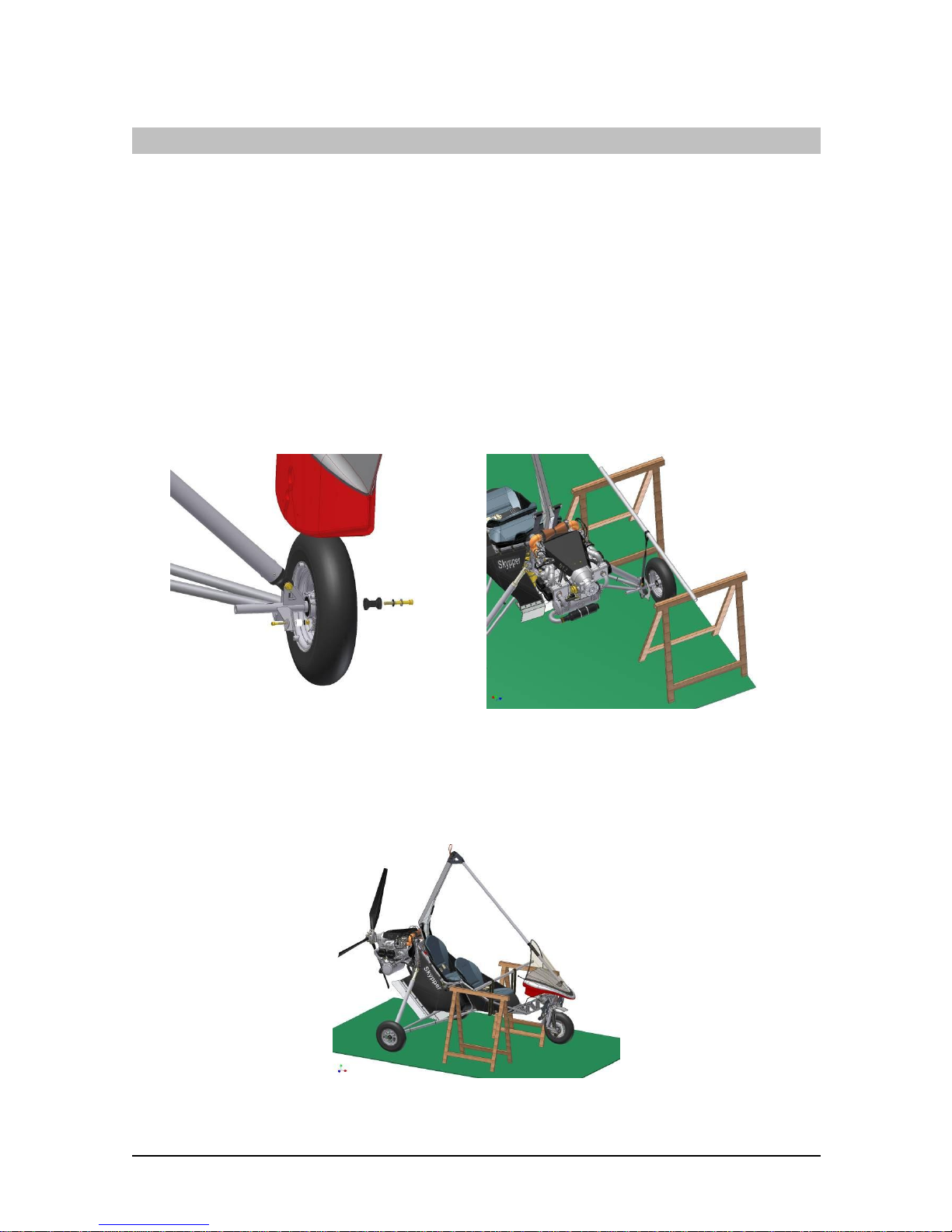
3.5.2 Lifting One Rear Wheel
Dismount the wheel fairing. While reassembling,
the bolt M8x65 must be glued with Loctite® ref.
270 (strong lock wire). See Figure 3-1.
Lift the trike by the undercarriage (See Figure 3-2.
Method applicable with the wing assembled).
Figure 3-1
Figure 3-2
3.5.3 Lifting the Front Wheel
Lift the front of the trike using the passenger foot rest (See Figure 3-3). Method feasible with the wing
assembled).
Figure 3-3

GDMMTA582-1G Version 0010 8
3.6 Transportation & Storage
Moving the trike is a simple operation due to its light weight and maneuverability. One
person can move it. If the front of the trike is lifted from the ground it is important to
prevent the propeller from touching the ground.
3.6.1 Towing
Pulling the trike with or without the wing is facilitated by lifting the front wheel. The
front wheel is lifted by hand by means of the fiberglass console above the nose wheel.
The trike can also be pushed using the fairing in front of the nose wheel, and using a hand
on the steering pedals inside the pod for directional control.
3.6.2 Taxiing
Taxiing of the trike may be performed with or without the wing. Braking and steering are
achieved by means of the front wheel. The trike should never be taxied with excessive
speed.
Taxiing is a part of the training necessary for flying this aircraft. If a maintenance
engineer without trike flying experience is working on the trike he should push the trike
and not taxi it, as the control sense may be different to what he is accustomed to.
3.6.3 Ground Transportation
The trike may be transported overland on a suitable trailer. During transport the trike base
should be firmly held at both the front and the rear to prevent movement. Tie down straps
should be used with a ratchet system so preload can be applied; this allows the tires to be
compressed slightly so as to firmly hold the base in place during transport.
3.6.4 Long-Term Hangarage
Full covers for the trike are available from Air Creation for long term Hangarage.
The Rotax manual should be consulted for long term storage.

GDMMTA582-1G Version 0010 9
4 Servicing
4.1 General
This chapter provides servicing procedures necessary to replenish or service the aircraft
and its equipment as required.
The operational integrity of the aircraft systems can be seriously impaired if
contaminated fuel, oil, fluids and lubricants are used or if they do not meet the required
specifications. Mixture of various brands and types of materials is undesirable and should
be avoided wherever possible. Specified lubricants will meet requirements for extreme
hot or cold temperature operations. Use of substitutes or other lubricants may cause
malfunction, or excessive wear.
4.2 Replenishing
4.2.1 Fuel System Replenishment
Fuel Specification
The Skypper has a single fuel tank, capacity 55 L. Fill to the neck of the fuel entrance.
The Rotax 582 engine uses a mixture of oil and gas for lubrification. Refer to the Rotax
manual section for engine fuel mixture specifications that apply to the region where the
aircraft is being flown.
Due to higher lead content in AVGAS, the wear of the valve seats and deposits in
the combustion chamber will increase. Therefore, use AVGAS only if the other fuel
types are not available.
Special instructions and service intervals are specified when using Avgas. If Avgas
is used, the Rotax web site should be referenced for maintenance requirements.
4.2.2 Fuel Sampling/Draining
There is a hose and drain cock on the base of the fuel tank behind the back seat, which
may be used to check the quality of the fuel, and to drain fuel if necessary. It is especially
important to remove any water from the system.
Checking the fuel
The fuel is checked for water and contaminants by draining a sample of the fuel into a
clear glass container. Once a sample has been taken the quality of the fuel can be checked
by looking for any water at the bottom of the glass, and checking visually for any other
contaminants.
If the fuel has been sitting for an extended period without use it may be advisable to
replace it with fresh fuel.

GDMMTA582-1G Version 0010 10
Draining the Fuel
Ensure that a suitable receptacle is found for the fuel to be drained, position the drain
cock above the receptacle and depress the drain cock. Ensure that there are no ignition
sources and that the fuel is disposed of correctly.
4.2.3 Coolant Replenishment
Coolant Specification
Consult the Rotax manual for the correct type of coolant.
Rotax recommends a two year or 200-hour replacement intervals for coolant.
4.3 Tire Inflation
The recommended tire inflation pressure is between 1 and 1.2 bars for both the front and
rear tires. Lower pressure favors comfort and improves the ride on soft surfaces. Higher
pressure reduces takeoff distance on hard surfaces. When checking the tire pressures the
opportunity should be taken to examine the tires for wear, cuts, bruises, slippage and
other defects.
4.4 Instrumentation
There are no user serviceable parts in any of the instrumentation for this aircraft; any
maintenance required should be carried out by an approved service centre.
Table of contents
Other Air Creation Aircraft manuals

Air Creation
Air Creation FUN 450 Manual

Air Creation
Air Creation BioniX2 13 User manual

Air Creation
Air Creation iFun 13 Owner's manual

Air Creation
Air Creation GTE 503 SE Manual

Air Creation
Air Creation SKYPPER evo 912 IS Owner's manual

Air Creation
Air Creation iFUN 13 SP Manual

Air Creation
Air Creation Pixel 303 XC Manual

Air Creation
Air Creation FUN 14 Manual

Air Creation
Air Creation iFUN 16 Manual

Air Creation
Air Creation BioniX 15 Owner's manual