
AGT Agrotk-H12 Manual

H12 MINI CRAWLER EXCAVATOR
OPERATION & MAINTENANCE MANUAL

Preface
Chapter I Usage Features and Performance Parameters of H12 Excavators
Section I Usage and features
Section II Main performance parameters
Chapter II Basic Structures and Work principle of H12 Excavators
Section I Overview
Section II Work principle
Section III Basic structure of mechanical system
Section IV Basic structure of hydraulic system
Chapter III Service Technologies of H12 Excavators
Section I Basic construction knowledge
Section II Preparation for work
Section III Operational essentials
Section IV Operational precautions
Chapter VI Maintenance of H12 Excavators
Section I Daily inspection
Section II Periods of overhaul, medium and minor repair
Chapter VII Troubleshooting of H12 Excavator
Section I General
Section II Troubleshooting of mechanical system
Section III Troubleshooting of hydraulic system
Section IV Troubleshooting of electrical control system
Section V Troubleshooting of engine
Section VI Other
Attachment: BOM List of H12 Parts
As product improvements, technical data and parameters is likely to change.

1
Chapter I Usage Features and Performance Parameters of H12
Excavators
Section I Usage and features
H12 Excavators are provided with excavating, crushing, ditch cleaning, drilling and bulldozing, with
their attachments quick hitched and thus its utilization up greatly. In addition, they are easy to operate and
transport and flexible to work at narrow site.
H12 Excavators, hydraulic type with single bucket
This type of excavators are mainly applied to: farming, landscaping, ditching and fertilization in garden, vegetable
greenhouse, agricultural transformation, indoor demolition, small earthwork, civil engineering, road recovery,
basement and indoor construction, concrete breaking, burying of cable, laying of water supply line, garden
cultivation, desilting and others.
The excavator are equipped with KOOP/KUBOTA/CHANGCHAI Diesel Engine or BRIGGS & STRATTON Gasoline
Engine.
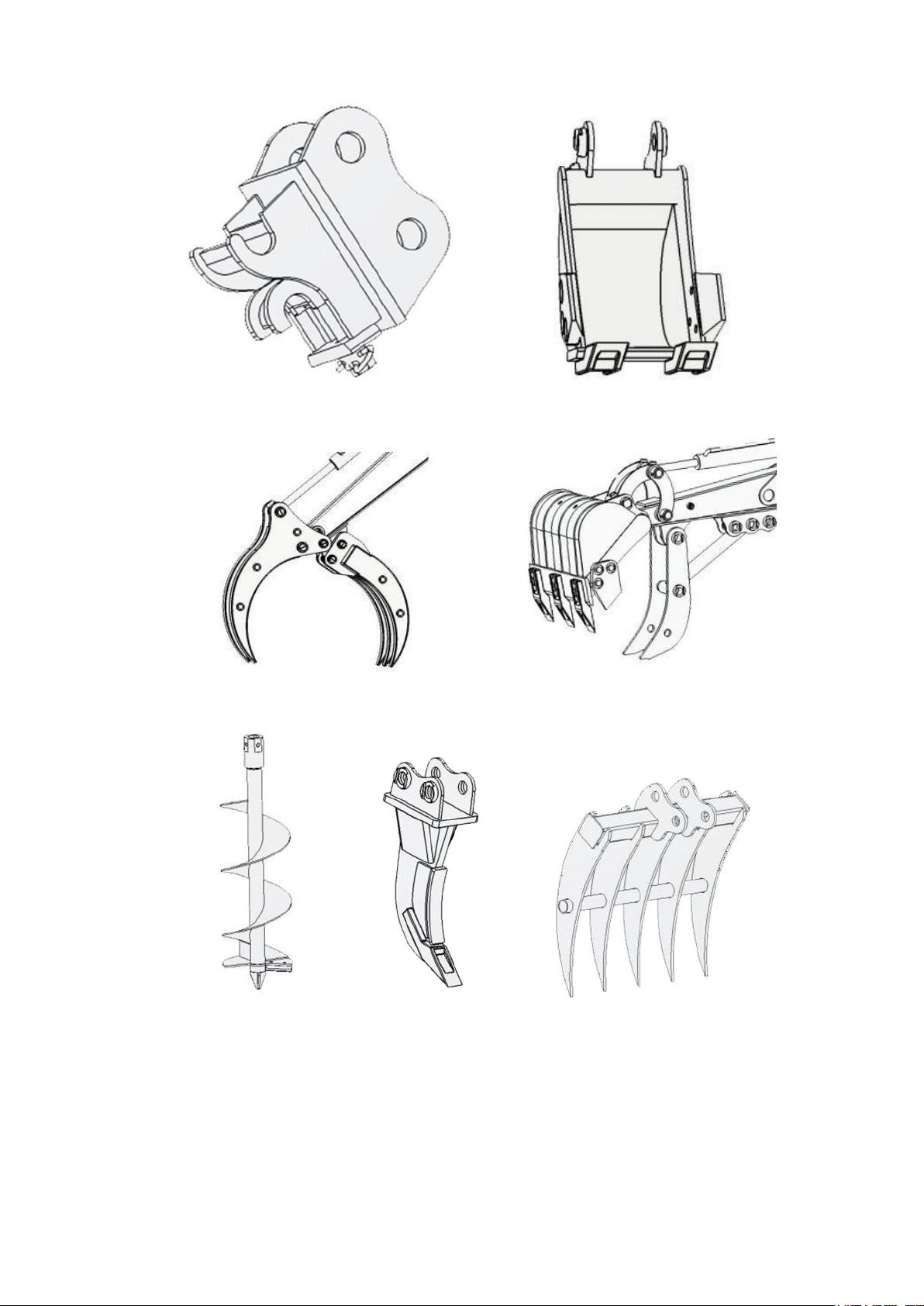
Excavators are able to equipped with multiple work equipment, such as quick hitch, log grapple, ripper, leveling
bucket, auger and narrow bucket, as well as optional roof, radiator and others, so as to meet your needing.
2
Quick hitch Narrow bucket
Log grapple Mechanical thumb
Auger Ripper Rake
3
Section II Main performance parameters

4
Overall dimensions
Unit: mm
A Wheel track 895
B Overall length of track 1203
C Ground clearance of platform 357
D Ground clearance of platform tail 800
E Chassis width 930
F Crawler width 180
H Crawler height 313
I Transportation length 2775
J Overall height
2219
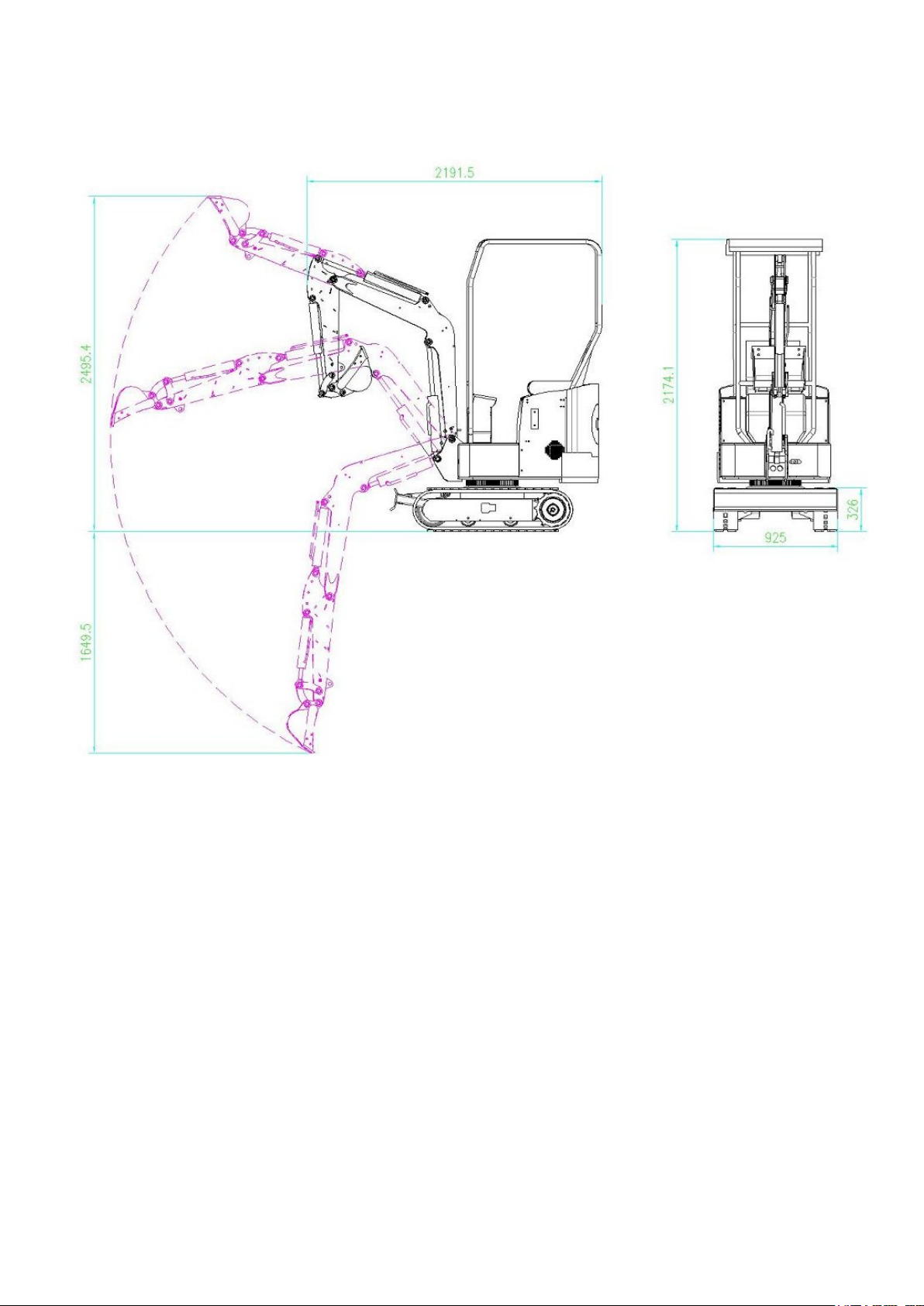
Work range
Unit: mm
A Max. digging radius on ground 2850
B Max. digging depth 1650
C Max. digging height 2600
D Max. unloading height 1800
E Max. vertical digging depth 1380
F Min. swing radius 1300
G Max. lifting height of dozer blade 110
H Max. digging depth of dozer blade
110
Weight of complete machine kg
Performance parameters
950
Standard bucket capacity m³ 0.025
Rated power kw Refer to Engine Label
5
Chapter II Basic Structures and Work Principle of H12 Excavators
Section I Overview on H12 excavators
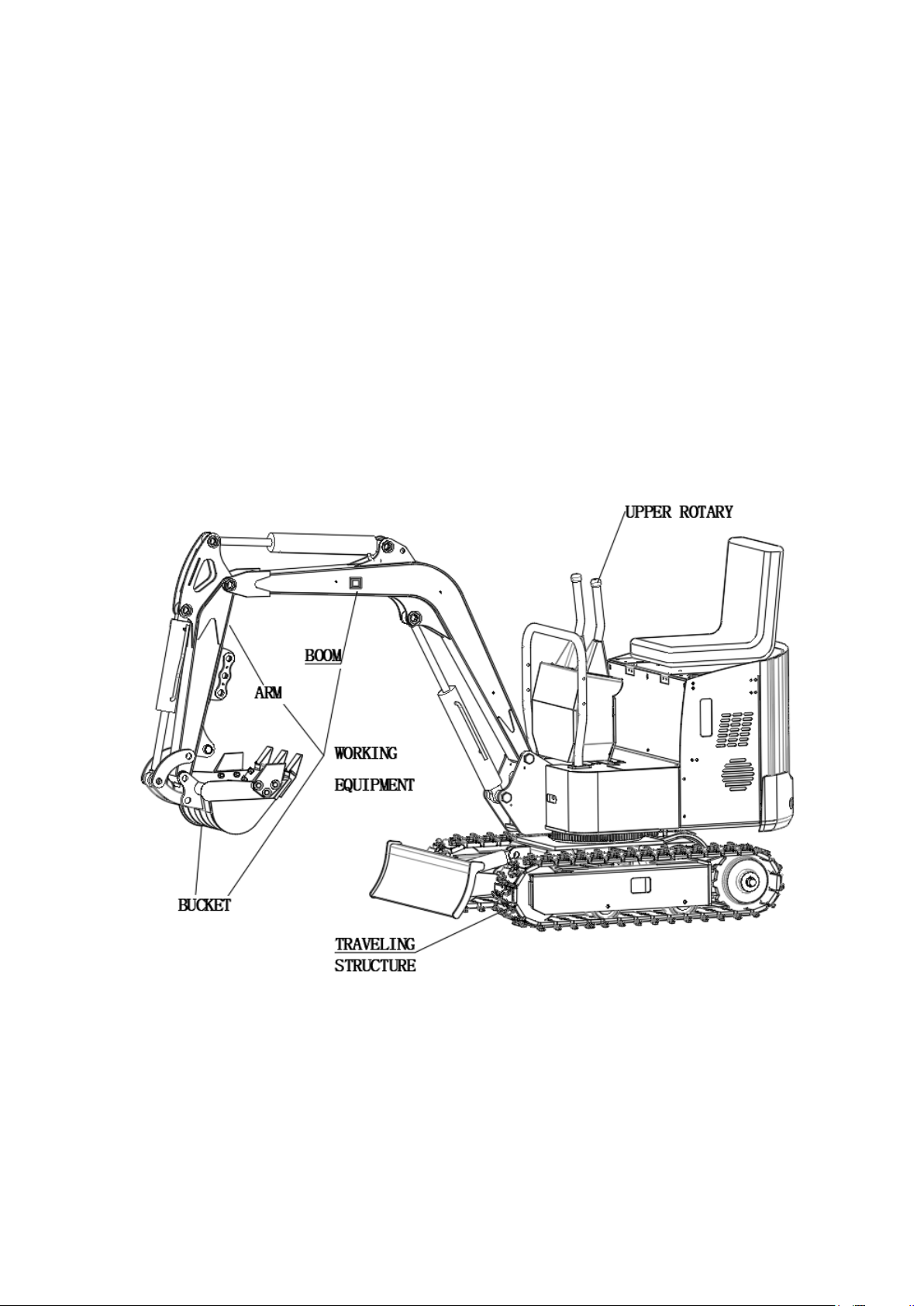
H12 excavator is composed of power train, work equipment, swing mechanism, control mechanism, drive
system, traveling mechanism and auxiliary equipment, as shown in fig. 1-1. Mounted on the rotary table are the
regular full-swing type hydraulic excavators, main components of drive system, swing mechanism and auxiliary
devices, which are referred to as upper rotary. Therefore, a H12 excavator is divided into work equipment,
upper rotary and traveling mechanism.

6
Central
slewing joint
Section II Work principle of excavators
Diesel engine changes the chemical energy of diesel into mechanical energy that is then altered with hydraulic
gear pump to hydraulic energy that is distributed to each actuating element (such as hydraulic cylinder, swing
motor and traveling motor). After that, each actuating element transform the hydraulic energy back to mechanical
energy, driving the work equipment and running the complete machine.
Movement and power transmission route of excavator shown below:
1.
Traveling power route: diesel engine —— coupler —— hydraulic pump (mechanical energy changed to
hydraulic energy) —— distributor valve —— central swing joint —— traveling motor (hydraulic energy
changed to mechanical energy)—— sprocket —— rubber crawler—— starting of traveling
2.
Swing power route: diesel engine —— coupler —— hydraulic pump (mechanical energy changed to
hydraulic energy) —— distributor valve—— swing motor (hydraulic energy changed to mechanical energy)
—— slewing bearing —— realizing of wing
3.
Boom power route: diesel engine —— coupler —— hydraulic pump (mechanical energy changed to
hydraulic energy) —— distributor valve —— boom cylinder (hydraulic energy changed to mechanical
energy)——boom movement
4.
Arm power route: diesel engine —— coupler —— hydraulic pump (mechanical energy changed to hydraulic
energy) —— distributor valve —— arm cylinder (hydraulic energy changed to mechanical energy) —— arm
movement
5.
Bucket power route: diesel engine ——coupler —— hydraulic pump (mechanical energy changed to
hydraulic energy) —— distributor valve —— bucket cylinder (hydraulic energy changed to mechanical
energy) —— bucket movement

7
Section III Basic structure of H12 excavators mechanical system
1
Power system
H12 excavator is equipped with single-cylinder air-cooling diesel/gasoline engine, include KOOP/CHANGCHAI or
BRIGGS & STRATTON Engine. The KUBOTA engine is three-cylinder water-cooling engine, which is made by Japan.
2
Drive system
H12 excavator's drive system could transfer the output power from engine through the hydraulic system to work
equipment, swing mechanism and traveling mechanism.
3
Swing mechanism
Swing mechanism could turn the work equipment and upper rotary leftwards and rightwards, so as to do the
excavating and the unloading. H12 excavator's swing mechanism has to fix the rotary table onto frame and
has it swing flexibly, without any inclining risk. Therefore, H12 excavator is equipped with a slewing
support (supports) and a slewing drive (power of turntable slewing), which are called by a joint name as
swing mechanism.
3.1
Slewing support
H12 excavator has its rotary table supported with a rolling bearing, realizing the swinging of upper rotary.
3.2
Rotary drive
H12 excavator adopts the direct drive type. Namely, the output shaft of low-speed high-torque hydraulic
motor is mounted with a driving pinion which meshes with the slewing gear ring.
4
Traveling mechanism
Traveling mechanism supports the complete weight of excavator and drives it to run.
H12 excavator has the crawler traveling mechanism similar to other crawlers, with one hydraulic motor drives one
track. This excavator adopts low-speed high-torque motor. When two hydraulic motors run in the same direction,
this machine goes straightly forward; when one motor is supplied with oil and the other is braked, excavator steers
around the braked track; when two motors runs reversely, excavator rotates as circle.
Each part of traveling mechanism is mounted on integral traveling frame. The pressure oil from hydraulic pump
goes through the multi-way directional valve and the central swing joint into the hydraulic traveling motor that
changes the pressure energy into output torque that then goes to sprocket, driving excavator to run.
H12 excavator’s sprockets are integral castings and able to correctly engage with track, featuring balance drive.
Sprockets located at rear part of excavator, shortening the tensioner part and relieving the track abrasion, wear
and power consumption. Each track is equipped with a tensioner, adjusting the tracking tension and reducing
the track vibration noise, abrasion, wear and power loss.
5
Work equipment
The hydraulic excavator could install multiple working equipment, 200mm bucket and ripper are most popular.
The boom, arm and bucket are articulated with each other, as shown in figure and swing around their articulated points
respectively with aid of the hydraulic cylinder, to finish the excavating,lifting and unloading.
5.1
Boom
As the main component of backhoe work equipment, the integrated skewed boom is adopted on H12
excavator.
Being of the most popular type at present, skewed boom could allow excavator to dip deeper and to lower the
unloading depth, satisfying the backhoe requirements.

8
5.2
Bucket
5.2.1
Basic requirements
1)
The longitudinal profile of bucket meets the law of motion of various materials at inside of bucket,
facilitating the material flow and minimizing the loading resistance and thus fulfilling the bucket.
2)
Bucket teeth are mounted to increase the linear specific pressure of bucket onto material, with unit
cutting resistance relatively low and easing to cut in and break soil. In addition, the teeth are
resistant to wear and easy to replace.
3)
The load is easy to get off, shortening the unloading time and increasing the effective capacity of
bucket.
5.2.2
Structure
Bucket shape and size for backhoe are highly related to work objects. In order to meet various excavation,
one excavator could be equipped with multiple types of buckets.
Connection between bucket and hydraulic cylinder is of linkage mechanism, with bucket directly
articulated with hydraulic cylinder, which drops the rotation angle of bucket but enables the working
torque to change greatly.
Table of contents


