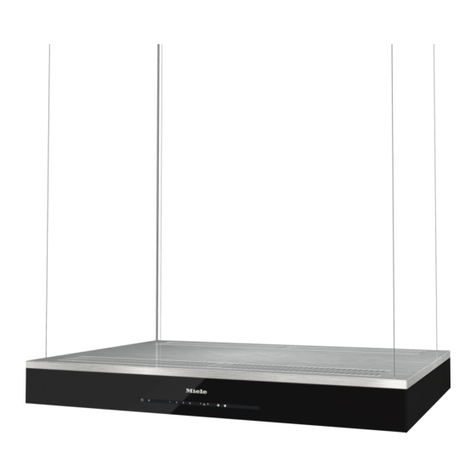
AEG DD 8794 Specification sheet

DD 8794
DD 8795
CHDD 8795
Dunstabzugshaube
Afzuigkap
Hotte
Cooker Hood
Campana extractora
Montage- und Gebrauchsanweisung
Installatie- en gebruiksaanwijzing
Notice d’utilisation et d’installation
Operating and Installation Instructions
Instrucciones de montaje y manejo

53
Contents
Safety warnings 54
Fortheuser 54
Fortheinstaller 54
Description of the Appliance 56
Extractorversion 56
FilterVersion 56
Control Panel 57
Switchingonthehood 58
Switching on the light 58
Controldeviceforgreaseor charcoalfilter 58
Ledsignal for greasefilter 58
Ledsignal for charcoal filter 58
Re-settingthe saturation signal 58
Maintenance and care 59
Cleaningthehood 59
Metalgrease filter 59
Removingthefrontalscreens: 59
Removingthemetalgrease filter 60
Charcoalfilter 61
Changingthe lightbulb 62
Special accessories* 63
Technical assistance service 63
Technical Specifications 64
Mountingaccessories included 64
Electrical connection 65
Wall unit mounting 66
Printedon recycled paper
AEG - putting words into action

54
Safety warnings
For the user
•Thecookerhoodisdesignedtoextractunpleasantodoursfromthe
kitchen, it will not extract steam.
•Alwayscover lighted elements, to prevent excess heat from
damaging the appliance. In the case of oil, gas and coal fired
cookers it is essential to avoid open flames.
•Also, when frying, keep the deep frying pan on the cooker top/cooker
undercarefulcontrol.
•Thehotoilinthefryingpanmightigniteduetooverheating.
•The risk of self-ignition increases when the oil being used is dirty.
•It is extremely important to note that overheating can cause a fire.
•Never carry out any flambécooking under the hood.
•Always disconnect the unit from the power supply before
carrying out any work on the hood, including replacing the
light bulb (take the cartridge fuse out of the fuse holder or switch off
theautomatic circuit breaker).
•It is very important to clean the hood and replace the filter at
the recommended intervals. Failure to do so could cause
grease deposits to build up, resulting in a fire hazard.
For the installer
•When used as an extractor unit, the hood must be fitted with a
150mmdiameter hose.
•Should there already be a pipe of diameter 125 mm that ducts to the
outside through the walls or roof, it is possible to use the 150/125
mm reduction flange provided. In this case the hood will be slightly
noisier.
•When installing the hood, make sure you respect the following
minimum distance from the top edge of the cooking hob/ring
surfaces:
electric cookers 300 mm
gascookers 300 mm
coal and oil cookers 400 mm min.
•Thenational Standard on fuel-burning systems specifies amaximum
depression of 0.04 mbar in such rooms.
•The air outlet must not be connected to chimney flues or combustion
gas ducts. The air outlet must under no circumstances be connected
toventilation ducts for roomsinwhich fuel-burning appliances are
installed.

55
•The air outlet installation must comply with the regulations laid down
bythe relevant authorities.
•When the unit is used in its extractor version, a sufficiently large
ventilationhole must be provided,withdimensions that are approxi-
mately the same as the outlet hole.
•Nationaland regionalbuildingregulations impose anumberof
restrictionson using hoods and fuel-burningappliancesconnectedto
a chimney, such as coal or oil room-heaters and gas fires, in the
sameroom.
•Hoods can only be used safely with appliances connected to a
chimneyif the room and/orflat(air/environment combination) is
ventilatedfrom outside usingasuitable ventilation hole approximately
500-600cm2 largeto avoid the possibility of a depression being
createdduring operationofthe hood.
•Ifyou have any doubts, contact the relevant controlling authority or
buildinginspector’s office.
•Since the rule for rooms with fuel burning appliances is “outlet hole of
the same size as the ventilation hole”, a hole of 500-600 cm2, which
is to say a larger hole, could reduce the performance of the extractor
hood.
•If the hood is used in its filtering function, it will operate simply and
safelyin the above conditions without the need foranyof the
aforementionedmeasures.
•When the hood is used in its extractor function, the following rules
mustbe followed to obtain optimal operation:
—short and straight outlet hose
—keep bends in outlet hose to a minimum
—never install the hoses with an acute angle, they must always follow
agentlecurve.
—keepthe hose as large aspossible (preferably the same diameter
as the outlet hole).
•Failure to observe these basic instructions will drastically reduce the
performanceand increase the noise levelsofthe extractor hood.

56
Description of the Appliance
•The hood is supplied as an extractor unit and can also be used with
afilteringfunctionbyfittingonecharcoalfilter.
•You will need an original AEG charcoal filter for this function
(Availablefrom yourlocalAEG Service ForceCentre).
Extractor version
•Inthis version fumesare
extracted to the outside via
a hose connected to the
coupling ring. Fig. 1.
•In order to obtain the best
performancethehose
shouldhaveadiameter
equal to the outlet hole.
•Shouldthere already be a
pipeof diameter 125 mm
that ducts to the outside
through the walls or roof, it
is possible to use the 150/
125mm reductionflange
provided.In this case the
hood will be slightly noisier.
Filter Version
•Theair is filtered through a
charcoalfilter and returnedto
the kitchen.
•You will need an original AEG
charcoalfilter for thefiltering
function.(See Special
Accessories).
•Fix the deflector using 2 screws
Ø3.5x9.5 mm. Fig. 2.
coupling ring
reduction
flange
Fig. 1
Deflector
Fig. 2

57
Control Panel
•Best results are obtained by using a low speed for normal conditions
anda high speed whenodoursaremore concentrated.
Turn the hood on a few minutes before you start cooking, you will
then get an under pressure in the kitchen. The hood should be left on
aftercookingforabout15minutesoruntilalltheodourshave
disappeared.
•Thehood operation may be controlled via the control ball or with the
remote control (the remote control is a special accessory and is
orderedseparately).
Every status change (changing speed, switching on the lights, etc.)
andis recognizable from the variationof light emitted by the control
ball and by an acoustic signal.
The control ball is located below on the right side of the cooker hood.
The control ball serves also as a light signal :
•No signal :
Thehood is switched off.
•Static green light :
Hoodisswitchedonatpowerlevel1(minimum).
•Static orange light :
Hoodis switched on at power level 2 (medium).
•Static red light :
Hoodisswitchedon at power level 3 (maximum).
•Alternating red light :
Hoodisswitched on at intensive power level (timed at 5minutes)
•Alternating green light :
Indicates the grease filter saturation - clean the grease filter
•Alternating orange light :
Indicates the charcoal filter saturation - clean or replace the
charcoalfilter.
Attention!
ThecontrolBallflashesorange to indicate the saturation of the odor
filter even when the charcoal filter is not installed inside the cooker
hood.
Howeverperform the signal reset operationasfollows: select the
intensive speed (the control ball lights up with a red flashing light),
depress again and hold depressed for about 3 seconds until a ‘bip’
sound indicates the reset.

58
Switching on the hood - Fig. 3
The control ball is a balancer switch.
Depressingthe control ball repeatedly towards the
bottom, switches on the hood and you may select
thesuction level desired, depressing onceagain
thehood switches off.
Switching on the light - Fig. 3
Depress the control ball towards the top :
oncefor submersed lighting,
onceagain for full lighting,
depress again to switch off the light.
Control device for grease or
charcoal filter
The air duct, in this hood, is provided with a device
thatsignalswhenthefilterrequirescleaningor
changing.
Led signal for grease filter
TheLED signal flickers (flickering green light) whenthegreasefilter
requirescleaning, occurs at about 40 operating hours.
Carefullynote thedevice forgreasefilter maintenance!
Led signal for charcoal filter
TheLED signal flickers (flickering orangelight)whenthe grease filter
requirescleaning, occurs at about 160 operating hours.
Carefullynote thedevicefor charcoalfiltermaintenance!
Re-setting the saturation signal
After cleaning or replacing the filter, select the intensive speed (the
control ball lights up with a red flashing light), depress again and hold
depressed for about 3 seconds until a ‘bip’sound indicates the reset.
depress towards
the top to switch
on the lights
depress towards the
bottom to switch on
the hood.
Fig. 3

59
Maintenance and care
•The hood must always be disconnected from the electricity
supply before beginning any maintenance work.
Cleaning the hood
•Clean the outside of the hood using a damp cloth and a mild deter-
gent.
•Neverusecorrosive,abrasiveorflammablecleaningproducts.
•Neverinsert pointed objects in the motor’s protective grid.
•Washthe outside surfaces using a delicate detergent solution. Never
usecaustic detergents or abrasive brushes orpowders.
•Only ever clean the switch panel and filter grille using a damp cloth
anddelicate detergents.
•It is extremely important to clean the unit and change the filters at
therecommended intervals. Failure to do so will cause grease
deposits to build up that could constitute a fire hazard.
Metal grease filter
•Thepurposeofthegrease filters is to absorb grease particles which
form during cooking and it must always be used, either in the
externalextraction or internal recycling function.
Attention:themetalgreasefiltersmustberemovedandwashed,
eitherby hand or in the dishwasher,every four weeks.
•To access the grease filter,
firstremovethefrontal
screens which conceal the
greasefilter.
Removing the frontal
screens:
Extract the small screen,
rotateupwardsandunhook.
Repeatthe operationforall
the small screens. Fig. 4. Bild 3
Fig. 4
Unhook
Extract

60
Removing the metal
grease filter
Pullthe handle downards, then
extract the filter.Fig. 5.
Hand washing
Soakgrease filters for about one
hourinhotwaterwithagrease-
looseningcleaner,then rinse off
thoroughlywith hot water. Repeat
the process if necessary. Refit the grease filters when they are dry.
Dishwasher
Placegreasefiltersinthedishwasher.Select most powerful washing
programmeand highest temperature, at least65°C.Repeat the
process. Refit the grease filters when they are dry.
When washing the metal grease filter in the dishwasher a slight
discolouration of the filter can occur, this does not have any impact
onits performance.
•Cleanthe inner housing using ahotdetergentsolution only (never
usecaustic detergents, abrasive powdersorbrushes).
Afterhaving re-installed thegreasefilter,remount the frontal screens
followingthe instructionsfor removalinreverse.
Thenarrowerfrontalscreenistobe mounted at the highest position.
Bild 3
Handle
Fig. 5

61
Charcoal filter
•The charcoal filter should only be used if you want to use the hood in
therecirculation function.
•Todothisyouwillneed an original AEG charcoal filter (available from
yourlocal Service ForceCentre).
•Cleaning/replacing the carbon filter
Unlikeother carbon filters, the LONGLIFE carbon filter can be
cleanedand reactivated. At normal use the filter should be cleaned
everysecondmonth(whenusingthehood2,5hoursperday, in
avarage). The best way to clean the filter is in the dishwasher. Use
normaldetergent and choose the highest temperature (65ºC). Wash
the filter separately so that no food parts gets stuck on the filter and
latercausesbadodours.Toreactivatethecarbon,thefilter should be
driedin an oven for 10 minutes with a temperature of maximum
100ºC.
Afterapproximatelythree years of use, the carbon filter should be
replaced with a new, as the odour reduction capacity will be reduced.
•Fitting
Fit the charcoal filter on the rear side of the grease filter, fix it with
two metal wires. Fig. 6.
•To remove proceed in the
reverseorder.
•Always specify the hood
modelcode numberand
serialnumberwhen
orderingreplacementfilters.
Thisinformation is shown
onthe registration plate
located on the inside of the
unit.
•Thecharcoal filter can be
orderedfromyourlocal
AEGService ForceCentre.
grease filter
charcoal filter
metal wires
Fig. 6
Other manuals for DD 8794
3
This manual suits for next models
3
Table of contents
Other AEG Ventilation Hood manuals