Channel to the other.
* All high value electrolytic capacitors used are low ESR 105 deg C types and
these have been chosen for their sonic qualities.
* Since every class D amplifier employs a reconstruction filter at it’s output, the
quality of the inductor and capacitor are critical for good sound quality. Wima
high pulse current type are used on every amplifier’s filter and low loss
powdered iron or gapped ferrite cores are used for the inductors.
* The class D amplifiers on every model use ultra low gate charge MOSFETs
which are critical for the operation of these full range class D amplifiers. Even the
mono blocks use the same full range designs!
* Power supplies are all over built in terms of transformer size and the quality of
the MOSFETs used as well as their unique drive circuits. The size of the
transformer and operating frequency of the switch mode power supply
determine the ultimate amount of energy which can be extracted. Typical
supplies use a switching frequency of between 25 to 40KHz. We use 75KHz which
means that we can extract between 1.5 to 2.2 times the power from a given
transformer core. The MOSFETs we use are also low gate charge high current
types. Even though the manufacturer of the MOSFETs rate them at 98 amps each,
the physical facts rule. The leads of the MOSFET are not capable of carrying
anywhere close to 98 amps! We limit the peak current of any power supply
MOSFET to about 30 amps.
* The control circuits which are activated in the boot up procedure of the
amplifiers are optically isolated from the audio circuits.
* Every AD DESIGNS amplifier uses 4 layer FR4 PCB material. Why? Several
reasons. Multiple ground planes are employed as we have four available layers to
use and these ground planes allow us to drastically lower the radiated EMI of
these amplifiers. The routing of critical PCB tracks is enhanced as we have the
extra two layers to use.
* The full range class D amplifier sections all operate at about 370KHz which is in
the “sweet spot” of efficiency versus radiated EMI versus sound quality.
* The amplifiers which have more than one channel have their class D clocks
locked at a single frequency which eliminates the beat frequencies we often
encounter in most multi channel class D amplifiers out there.
* Great attention has been paid to the layout of the PCBs due to the fact that in
high frequency switching circuits, PCB layout is as critical as the electronic
design itself.
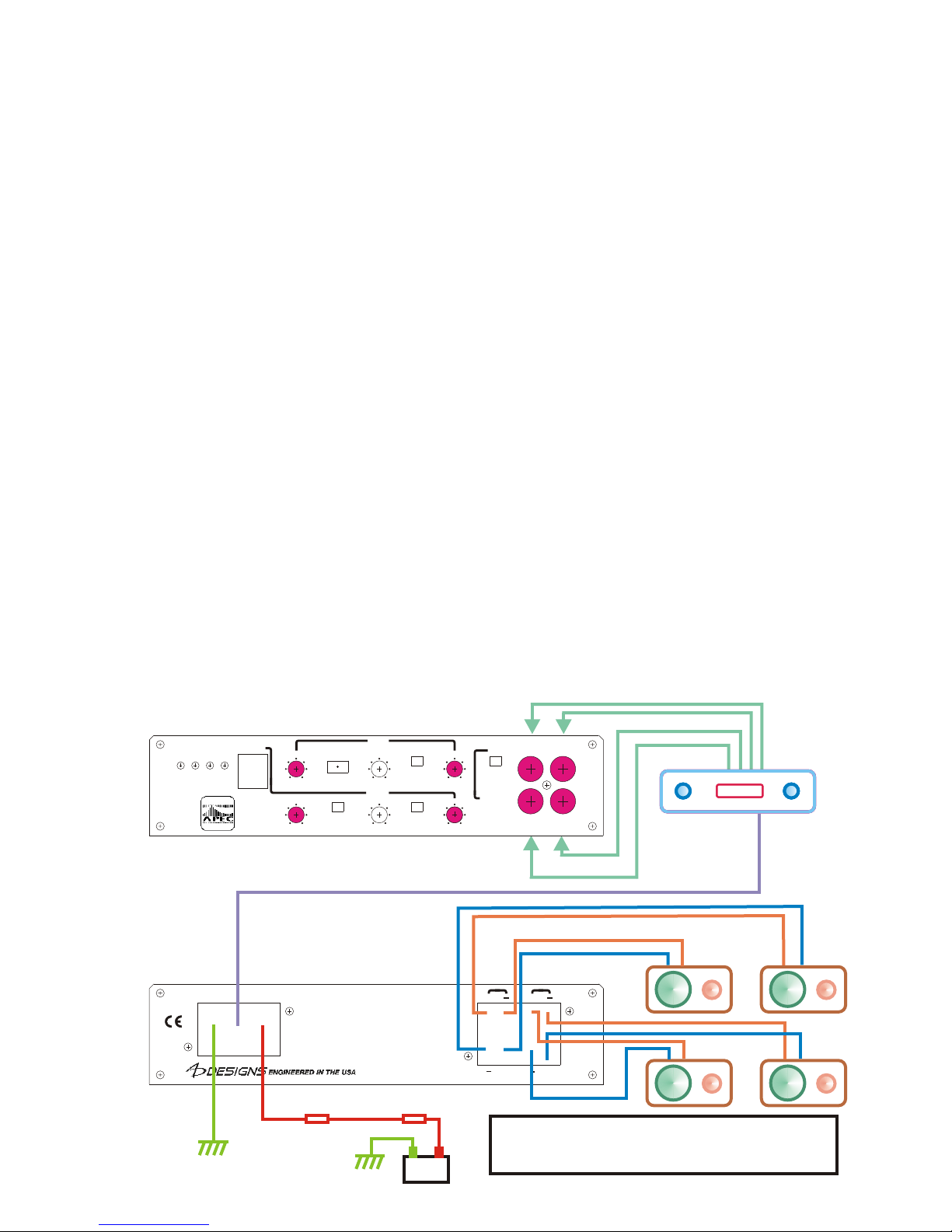
* ADP 700.1/1200.1 may be bridged with a 4 ohm load to deliver 1400w and 2400w
respectively OR may be cascaded with each subsequent amplifier driving it’s
own woofer where the master’s controls affect all further cascaded amplifiers.
Page 2